Sunday, April 14, 2013

Doctor Who: The Rings of Akhaten

This all seems familiar ... first episode with a new companion is set on contemporary Earth, the second takes her to some alien world where there are lots of monsters around ... thus is was with Rose, thus it is with Clara.

The second episode with her is 'The Rings of Akhatan', which is a strange little piece. Very enjoyable in and of itself, but riddled with holes as is much of modern Doctor Who.

We open with a nice sequence where the Doctor is looking in on Clara's life, learning how her parents met (through a leaf which blows into her dad's face and results in her meeting her mum), and then seeing her grow up. The Doctor meets her as a little girl (but why doesn't Clara remember him later on?) and then, when her mum dies, the Doctor is at the cemetery, watching. He comments in the TARDIS that she's not possible, but there's no explanation given, what is so impossible about her? Perhaps this is just one of the Claras, and the impossible bit is that there are lots of them? No idea.

So the Doctor fetches her a day later (we assume, following on from the last episode) and takes her to the Rings of Akhaten, a 7 world planetary system with lots of asteroids, all orbiting a vast planet (or is it a star, it's not very clear). The people of this system believe that life originated on their planet, and so the Doctor heads for a market there which is populated by all manner of exotic creatures and android things - a brilliant array of imagination from the prosthetic department to be honest, and many of them are better than the featured monsters and creatures that we do get in Who ... this is most reminiscent of course of 'The End of the World' episode with all the creatures assembled, but also reflected through the bar scene at the end of the Titanic episode, 'Voyage of the Damned', or even all the monsters under Stonehenge to trap the Doctor in the Pandorica in 'The Pandorica Opens' ... except this time none of them are remotely familiar.

As usual the music is OTT, but Clara meets up with a little girl called Merry, and together they hide out in an abandoned warehouse-like area. Merry is key to a 1000 year ritual and must sing, but is afraid she'll forget the words.  Clara puts her mind at rest, but three alien whispering things appear and try and find her - now these are really creepy. Excellent design and very underused here. Which is actually common with much of the episode - good ideas, but not really developed and rushed over.
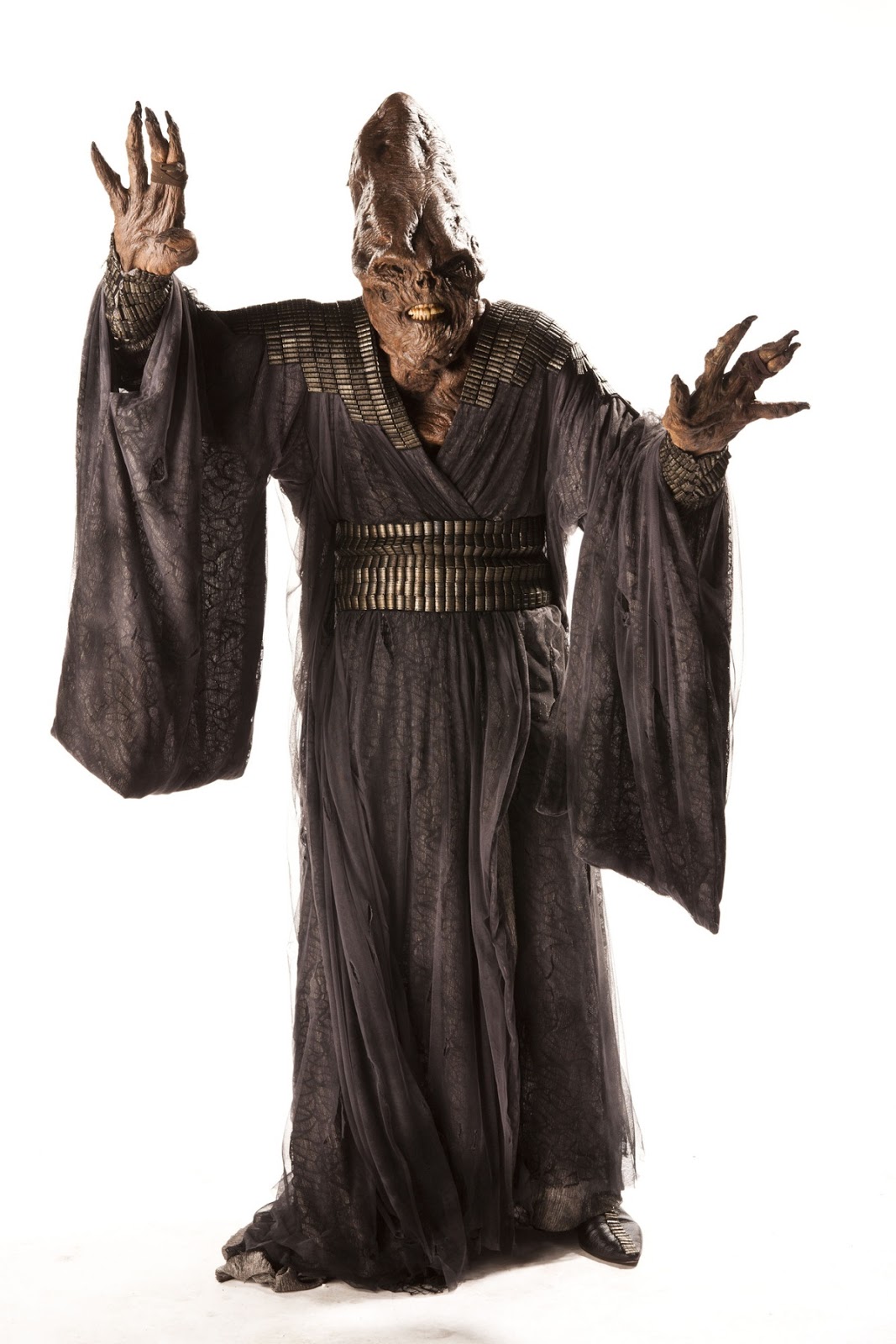
So Merry goes off to sing, and Clara and the Doctor join the audience. It's all a little confusing, but thanks to some massive infodumps (what ever happened to 'show, don't tell' as a mantra for good scripting?) we learn that there's a Grandfather/Old God in the Pyramid, and that people keep a song going forever to keep it asleep ... and this 1000 year ritual is to continue the song - it's a lullaby to keep him asleep.

So a monk on the pyramid sings, and Merry sings, and the audience sings ... but what about the atmosphere? How does sound travel from this planet to the pyramid anyway? There must be some sort of breathable atmosphere between them, as the Doctor and Clara travel there on a air-bike to rescue Merry when she is taken to the pyramid ... so how then does all this work in terms of physics ... or perhaps best not ask.

Anyway, Merry is taken to the Pyramid place in the sky, and the Doctor and Clara chase after her having bought an alien sky scooter from a vendor (which is odd as all the other vendors were watching the song, so why wasn't this one?). The Grandfather starts to wake - he's an alien monster husk in a glass case, but because the song has stopped he's waking up.

It all gets very confusing now. Merry traps Clara against the case - no idea why, something about eating souls - and the Doctor talks her out of it and Clara is released ... Merry's soul was being sacrificed to this monster because there's only one of her ... but there are lots of Claras, and we get a shot of Clara presumably to bring this point home. But then 'the Vigil' arrive again - the spooky whispering robots - but the Doctor holds them back with the ever-present and all-powerful sonic screwdriver while Clara and Merry escape.
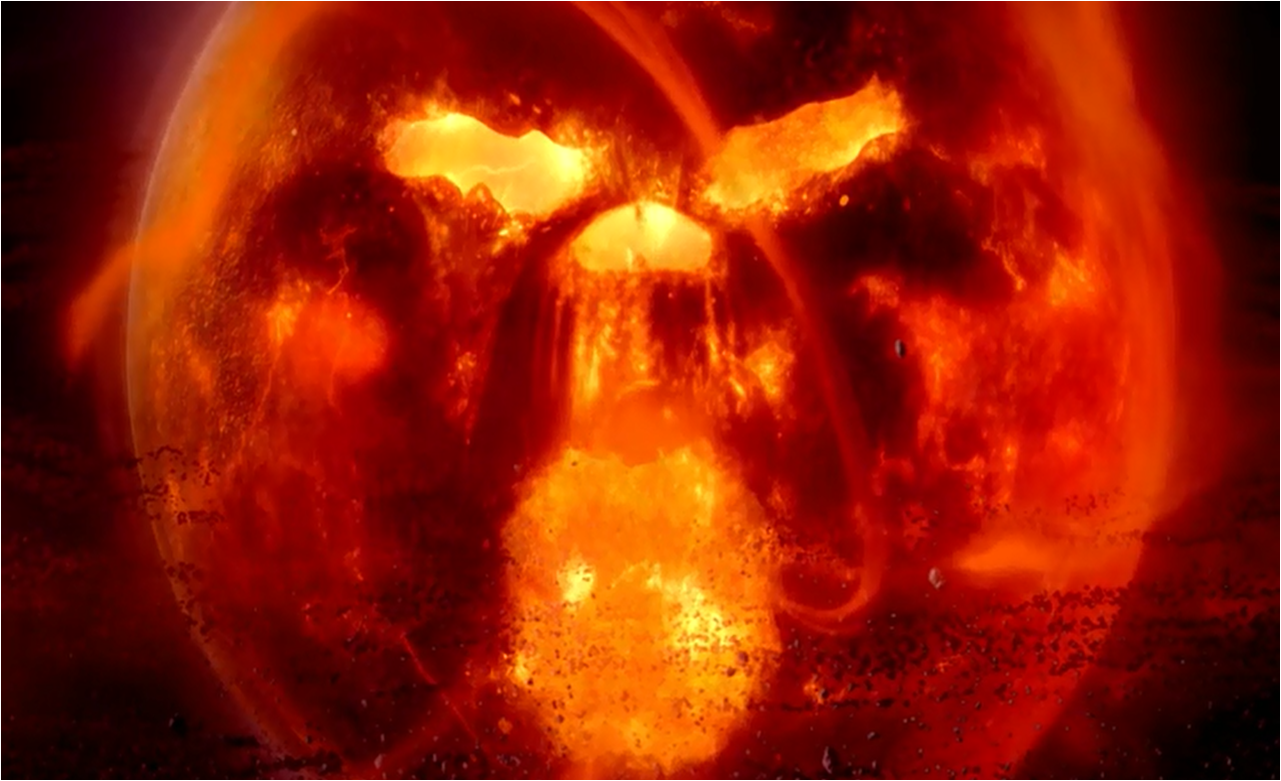
So the Grandfather escapes from the glass box, but then dies ... he wasn't the threat at all, but was an alarm clock for the big-bad, which is the planet or star or whatever it is that they are all in orbit around (it seems). This thing develops a skull-face, and the Doctor realises it is hungry and needs to feed on memories. So he gives it his own memories, and with no apparent adverse effect on the Doctor, it collapses in on itself, but then comes back as it's still hungry.

So Clara, who has headed back to the pyramid to save the Doctor, offers it her leaf - the one which made her mum and dad meet and which she has kept. Apparently this is all the life her mother never had. But this makes no sense as her mum died normally as far as we know ... and anyway, why would this leaf contain her future lives?  Given that the possibilities for her mum were infinite, this leaf represents an infinite meal, and so the planet/star/god/whatever eats its fill and vanishes.

But what about all the planets and asteroids which were orbiting it? Wouldn't they all just collapse? Would the atmosphere vanish and kill everyone? Would the sudden shift in gravitational patterns cause the system to rip itself apart?  No idea ... and the Doctor doesn't seem to care either. He and Clara return back to her home, where she leaves the TARDIS ...

As I said, it's a strange mishmash of ideas and concepts which are really good, but the whole thing makes no sense, particularly because of the lack of physics or appreciation as to how this all works on a scientific basis. I get that it's a fantasy show, but even in the most incredible stories and films, there is an appreciation of the laws of physics, and some McGuffin explanation of it all, but here there's nothing ... you just have to go with it.

And it's enjoyable as long as you don't ask questions: why was the God waking up now? Why didn't the people and aliens realise that the thing in the box wasn't the God, but instead it was the planet/star that they orbited? What was the point of the Grandfather - a raging alien husk in a case? What was the point of the Vigil - to bring Merry to the Grandfather? Why? So it could eat her soul? For what point?  The thing was so powerful it could have taken all the souls on the planet ... so why hers? And why did the Doctor have no ill effects from giving it all his memories - including things that should never be known as he told it in a good speech, and if all the Doctor's memories were not enough, why would one small girl pacify it ... it all makes no sense.

Anyway ... it's visually rich, and the performances are all good. Matt Smith has never been so Tennant in his performance, and Clara grows as a character. She's not so knowing here which is good. And it's good to see the Doctor just turn up and have an adventure too ... something I missed last year.

And next week, it's the Ice Warriors back ... so it can't be all bad ...

Wednesday, April 03, 2013

Doctor Who: The Bells of St John

So Doctor Who returns for the second half of the latest season. I don't like this as it splits it all up and rather than being something to look forward to, which then runs for 14 or 20 weeks or whatever, Who becomes a blink and you miss it event ... but oh well.

'The Bells of St John'. Never was a story more misnamed. I suspect that they didn't know what to call it - 'The Return of the Intelligence', 'Connection Problems', 'The Curse of the Wi-Fi' ... those make sense, but the title they used refers to the TARDIS phone ringing when Clara calls and that's it - actually nothing to do with the actual story at all.

And the story ... well it's a light mishmash of everything that Steven Moffat has done before really. There's something real-world which goes scary (children, clockwork toys, statues, the dark ... and now Wi-Fi); a catch-phrase ('Are you my mummy?', 'Don't Blink!', 'Who put out the lights?' and now 'I don't know where I am!'); timey-wimey stuff; a manic Doctor; and a character who speaks so hip and knowing and arch that she comes over as being 'written' and 'developed' rather than natural.

So the Doc is in 1207 living as a monk whilst pondering the enigma which is Clara Oswold. Never mind why, he just is, okay! And then Clara calls him (or rather *a* Clara calls him - as we know, there are lots of them about) and wants to know why she can't get on the internet. She got the number from a woman in the shop ... so ... River Song? Clara is just plain daft ... doesn't everyone understand that you don't phone a help desk for something like that? Or maybe that's the point, she's meant to be daft (at least before the internetz are downloaded into her head ... or something ... but anyway, that's for later). But it's very 'written' and this is the main problem I have with her character. She's just not remotely believable!

So the Doctor dashes in his TARDIS over to her gaffe to see her, but she's a bit bemused at this mad Monk arriving that she ignores him. But, having clicked on the Wi-Fi thingy, she's then confronted by a girl from a book written by Amelia Williams (aka Amy Pond, aka something the BBC can then make money selling) who uploads her into the internetz run by that woman off of Acorn Antiques.

We get a sort of lo-fi re-run of 'The Idiot's Lantern' with people trapped in telly screens for a while, but the Doctor changes his outfit and rescues her by making the 'spoonhead' put her mind back in her body (as the upload wasn't complete - sounds like the dial up like speeds we have here at the moment to me!).

Miss Kislet (Celia Imrie, the Acorn Antiques lady) is apparently only capturing clever people into her web for her client ... but then they can give them intelligence and knowledge when they do ... so that doesn't make sense then. Oh well. She can also control the people who work for her from her iPad ... convenient little slider controls to manage Conscience, Paranoia, Obedience and IQ. I wonder what the people who wrote the software thought they were developing ...

The 'spoonhead' thing was sent by Kislet, but there's no explanation as to how it got in Clara's house ... but it is established that it is needed to put Clara back in her body ... important point for later on. Kislet also recognises the TARDIS ... and for totally random reasons decides to crash a plane on the Doctor and Clara! Given that later she demonstrates that she can control anyone in range of Wi-Fi this seems a little extreme ... why not just get someone from one of the other houses to go and kill them ...

Anyway, in a nifty bit of wassname, the Doctor takes the TARDIS onto the plane and saves the day and the passengers, before heading for London to try and track down these Wi-Fi controlling people. While Clara uses her new computer skills to hack their systems and identify them all from Facebook, and to find out where they are, Kislet shows off to the Doctor by talking to him via random people in the café (a nice, creepy sequence really) while another 'Base Station' spoonhead looking like the Doctor re-uploads Clara.

The Doc gets angry and rides his motorbike up the outside of the Shard, crashing into Kislet's office. But it's not the Doctor ... it's the Spoonhead (how did he get it to do all that then!), and it captures Kislet ... the Doc then makes her minions release everyone who has been trapped (despite the fact that they need a Spoonhead to replace them in their bodies as previously established!)  So loads of these people are presumably now just dead.

But in a dramatic twist, the Client is revealed to be Richard E Grant - it's the Great Intelligence again from the last episode ... this time capturing human minds and keeping them in the internetz ... which is sort of the plot of the Doctor Who spin-off film Downtime from the mid-90s, where the Great Intelligence enslaves humans and uses the Internet to try and take over the world ... Except that Downtime has Yetis and bleeping spheres and all the 'right' trappings, whereas 'The Bells of St John' has nothing except a 10 second cameo and lots of hot air.

The Intelligence releases Miss Kislet who reverts to acting like a little girl (not sure why) and the Doctor and Clara are saved. Hoorah!

Of course the Doc has to ask Clara to travel with him, and while she doesn't agree, she tells him to ask her again tomorrow ... she might say 'yes' then ... and it's all over for another week.

It's all very fast and furious and there are some lovely set pieces. I loved the TARDIS interior again - easily the best the series has ever had, and I liked the plane crash scenario, the café sequence, the riding the bike up the shard ... so many good bits ... but all held together by smoke and mirrors. There's no plot here. It makes no sense. There's no character development for anyone - all are just ciphers - and the Great Intelligence seems to be there for no discernible reason. You just have to watch, disengage brain, and go for the ride.

Back in 1967 it took the Doctor, Jamie and Victoria six weeks of tense action and drama to uncover the mystery of who the Intelligence was, what it wanted, who were its pawns, and why the Yeti were roaming the mountains of Tibet ... That's why there was another 6 part sequel set in the London Underground the following year, and why, some 45 years later, we still remember the episodes and the monsters ... here we get 45 minutes of flash bang wallop which is forgotten 10 minutes into the next programme.

Maybe that's all that Who can aspire to be these days, a flash in the pan ... which is the biggest mistake and the biggest tragedy of all.

Wednesday, January 09, 2013

The UNIT Sourcebook

I've never 'got' Roleplaying Games. I've always been more interested in reading and watching film and television to take part in Dungeons and Dragons or other game activity, and so the whole genre has mostly passed me by.

One thing I have observed, however, is that some of the assets produced for these games are rather lovely, and can range from gorgeous little metal figures to books and boxed sets which far surpass many other items on the market. And so it is with The UNIT Sourcebook, a hardbacked book published to accompany a game called Adventures in Time and Space. The publisher is Cubicle 7, a UK-based company, but the game seems to be primarily targeted at America and thus features dollar prices on the packaging and so on.

The UNIT Sourcebook is, as it suggests, a guide to all things UNIT, and the writers - Will Brooks, David F Chapman, Alex Gutteridge, Gareth Ryder-Hanrahan, Andrew Peregrine, Gareth-Michael Skarka and Jason Vey - really go the extra mile. Every element of UNIT is covered, from all the TV stories and appearances through analysing their modus operandi, how they are structured, weapons, Bases, Personnel and everything in between. It's the ultimate factual guide to UNIT!

Add to this a beautiful layout from Paul Bourne, graphic design by Bourne and Lee Binding and a cover from Binding, and you have a stunning volume, packed with photographs and interest. Okay, the latter chapters move more into how to use UNIT as part of a role playing game, and giving mission suggestions and plot ideas to develop - and some of these are worthy of being television episodes themselves! - but these only cover the last third of the book, leaving lots and lots for the Doctor Who fan who is not into Roleplaying Games to enjoy and consume.

More information on the book can be found on the Cubicle 7 Website here: http://www.cubicle7.co.uk/our-games/doctor-who-aitas/defending-the-earth-the-unit-sourcebook/

And it's available to buy from Cubicle 7 here: http://shop.cubicle7store.com/epages/es113347.sf/en_GB/?ObjectPath=%2FShops%2Fes113347_shop%2FProducts%2FCB71104

Saturday, December 29, 2012

Memories of Who

Catching up on books from the year, and two which are very different, but which are strangely similar, are Behind the Sofa edited by Steve Berry (Troubador), and Turn Left by Andy X Cable (Miwk).

Berry's book was published to raise money for Alzheimers research, and is a very nicely put together hardback tome of memories from a wide selection of people - authors, editors, actors, musicians, politicians ... just about anyone and everyone who has a fondness for Doctor Who can be found within the pages. I have to confess a slight bias as there is a piece from me in there too, alongside writings from Neil Gaiman, Al Murray, Chris Tarrant, Richard Herring, Mark Millar, Konnie Huq, Murray Gold, Roland Rat and Michael Grade!  It's a very comprehensive collection of thoughts and memories of Doctor Who and really establishes that just about everyone has been touched by the programme in some way or another in their lives.

Some of the stories are so familiar, that if you are a fan, then you find fannish comadarie in the tales of Target Books, and being forbidden to watch, of meeting Tom Baker or collecting action figures ... everyone has a shared childhood whether born in the sixties, eighties or even noughties it seems.

The book is beautifully illustrated by Ben Morris, and the whole package is a joy to hold.  If you're at all interested in the memories and love that everyone collectively has for Doctor Who, then please consider buying the title from the publishers' website here: http://www.troubador.co.uk/book_info.asp?bookid=1978 rather than from anywhere else as 100% of the money will then go to the charity rather than some of it ending up in the rather deep pockets of Amazon or wherever.

The other title I have been reviewing is similar in a strange way. Turn Left is subtitled 'An Unofficial and Unauthorised Guide to Doctor Who Road Signs' and is penned and illustrated - in biro - by the (probably) pseudonymous Andy X Cable (though he does have his own Facebook page here: https://www.facebook.com/andyxcable). It's a strange beast indeed, being the journal of a self-confessed Doctor Who fan, who has the habit of connecting every thing he sees to a reference to something in Doctor Who. Thus this book documents all the road signs he has seen, in the order he saw them, and what memories or themes they cause him to consider as a result. We get stories about Doctor Who where the story titles are incorrectly spelt or muddled, characters and actors are confused with real people, and monologues about how he got to the road, or something about his life which relates to the sign, or to Doctor Who or all three.

'Andy X Cable' is portrayed as a disfunctional young man, short of friends and devoted to his mother who looks after him as best she can. Many attendees of Doctor Who conventions may recognise elements of 'Andy' in some of their fellow fans, and the stereotype of a fan/nerd popularised (in my mind at least) by the 'Milky Milky' man, Mr Strange, played by Hugh Dennis in The Mary Whitehouse Experience, is the classic depiction of this sort of insular people-challenged individual.

But below the stereotype is a keen satire, and reading through the book, and sniggering at Andy's poor grammar and torturous descriptions, we find revealed to us a man who is often misunderstood, who has no real friends, and who uses Doctor Who as a crutch to help him through real life. As the text progresses, so the entries start to explore more of his world, and then, with crushing impact, Andy's Mum dies, and there is nothing for two months. The entries following this are full of sadness and lashing out at the world, until a friend finally comes into his life in the form of Celia. The book ends with a somewhat upbeat outlook for Andy ... he finally has someone in his life that he can share his passion with ...

It's a difficult read, admittedly, mainly because of the stream of consciousness style of writing, but also because 'Andy' is someone we have all met at some point in our lives. Were we nice to him? Or did we laugh at him? On a personal level, I have always tried to be kind. I remember one mother, who always accompanied her son to Doctor Who events, explaining to me that he looked forward to the events so much that they envigorated him and gave him something to reach for, that they made him feel included in a community, and that he never would go out otherwise. That, for me, is the magic of Doctor Who - in bringing together people of all ages, races, colours, creeds and abilities. To make a person feel included, where their circumstances of life has dealt them cards of exclusion and prejudice. It's what the Doctor teaches - to look beyond the superficial and to embrace the dreams and aspirations of everyone.

Turn Left is an interesting book. Partly a funny and often tangental look at Doctor Who, and partly a social commentary. Well worth a look. It's published by Miwk, a relatively new publisher of all things Cult, so please check out this book, and the others on their catalogue. (http://www.miwkpublishing.com/store/index.php?_a=product&product_id=13)

Friday, December 28, 2012

Doctor Who: The Snowmen

It's Christmas, and these days it means a special Christmas episode of Doctor Who ... something for the family to sit and watch on Christmas Day, and hopefully which entertains and thrills the audience.  This year's event was called 'The Snowmen', and I guess like others I inwardly groaned: why does every Christmas episode have to take place at Christmas ... and have snow ... and Victorians ... it's all so cliched and tired. But maybe this year a rabbit can be pulled from the hat ... maybe ...

Apart from needing to present a Christmas romp, Steven Moffat this year had the added problem of needing to introduce a new companion ... a young lady by the name of Clara. But things are never quite so simple in the world of current Doctor Who, and even having a companion who can travel with the Doctor and just have adventures is beyond them. The characters have to have backstories, and be insanely cute and quirky, and even, as seems to be the current theme, to be the whole focus and mainspring of the show ...

We kick off with some snowflakes with snarling mouths in them (quite what the point of this was is not explained ... what do individual snowflakes actually eat?) and a boy, Walter, in a garden with a Snowman who talks to him ... creepy and good to kick off. It's 1842 ... and 50 years later (1892) the boy - now a man - is collecting snow and adding it to a large ball-like globe in his living room. This is Dr Simeon (Richard E Grant) and he is still talking to the thing in the globe, who now has the voice of Sir Ian McKellen.

We now meet Clara, waitress at the Rose and Crown pub (with noted emphasis on 'Rose' in the opening shot of the pub sign). A Snowman appears from nowhere and she meets the Doctor who seems sullen and disinterested. But for a Victorian, Clara is a thoroughly modern miss, and very forward too ... she chats up the Doctor and follows him, jumping on his carriage and cheekily asking 'Doctor who?'

Crash to the titles, and these are a new set which I liked very much. I wish the music could have been more reflective of the past - it was a little simplistic for me - but the visuals were lovely, reflecting space and time and alien and human and all sorts ... a really good update.

But things are now starting to get somewhat confusing. As well as the Doctor, Clara and Dr Simeon, we have Latimer and his two children ... a governess drowned in a frozen pond and left there for weeks ... and now we have Madame Vastra and her wife Jenny, as well as Strax, a Sontaran ... it's all getting crowded, and to be honest I have no idea why Vastra, Jenny and Strax were there. Or why the Doctor was there in that time period. There's a nice comedy piece between the Doctor and Strax and a memory worm (a mcguffin if ever I saw one) which is all very twee and plot-convenient for later, but why is the worm hidden under the carriage?

Clara continues her cute stalking of the Doctor and we find that the TARDIS is hidden on top a cloud up a vast spiral staircase. This is all very 'Narnia' and magical, but again, I ask why? Why not just make the TARDIS invisible? And having followed him all the way up, and knocking on the door, she runs away! This didn't ring true - she has been shown as a forward and direct lady, and this was out of character.

Clara now decides to stop being a barmaid and instead to return to Latimer as a Governess - Miss Montague ... the poor kids have been having nightmares and only she can help as Latimer is too distant. Oh, and it's Christmas eve (sigh).

Having found out about the bad dreams, Clara goes to try and find the Doctor again, only to bump into Jenny and end up playing a stupid word game with Vastra ... as infuriating as it is pointless. One word responses ... do me a favour. And of course Clara passes with flying colours with the word 'Pond'. Oh dear. It really is Rose all over again isn't it. The Doctor all moody and sulking ... *backstory* and angst. Oh for simple adventures.

But with this one word, the Doctor decides to start investigating by visiting Dr Simeon and pretending to be Sherlock Holmes (a fictional character). The thing in the ball says 'We are the Intelligence', and we have already seen flashes of the business card with 'Great Intelligence' on (and GI on the cab door and gates of Simeon's manor house) so there's no real surprise to learn that what is unfolding is the backstory for the Great Intelligence, a malignant entity which the Doctor encountered twice in his second incarnation - 'The Abominable Snowmen' and 'The Web of Fear' (and which some fans theorise might also be the Animus from the first Doctor story 'The Web Planet'). The Doctor surmises that this thing is a mimic which mirrors what it finds. That it needs to become more human and so needs a duplicate of human DNA in ice form ... and then the Doctor vanishes in a puff of exposition.

He returns to the house where Clara asks him to come up while she comforts the kids ... but instead the ice-governess attacks, having emerged from the frozen pond. Not sure what was 'powering' the ice-governess. It seemed to be the same thing as the Snowmen, which Simeon could control ... so why couldn't he control the governess? Why didn't she simply go with him rather than attacking the kids? Or was it the girl who was controlling it ... not sure.

The Doctor destroys the ice-Governess with his handy sonic screwdriver, but Simeon blows snow into the grounds and she reforms. Vastra, Jenny and Strax arrive and Jenny throws up a convenient force field to stop the icy lady while they all chat. The Doctor and Clara head for the roof to lure the CGI ice-person away from Simeon, and once there, the TARDIS is conveniently located, again up the spiral staircase ...

And then there is the only true 'wow' moment of the episode. Where Clara sees inside the TARDIS, and realises that it's 'smaller on the outside'. The redesign is awesome. Much, much better than the organic look, the blue and white, clean lines, alien stylings are brilliant and really hark back to what the TARDIS actually is. I loved it. And Clara's reactions were also perfect. Spoiled only by the ice-Governess grabbing her and the two of them falling back to Earth. Clara is dead!

But the Doctor won't let her go, and he uses something uncertain to bring her back to life for a time - the purpose of this I'm not sure on though. In Doctor Who, dead usually means dead, and this is the case for Daleks and Zygons as well as Katarina and Adric ... so this is something of a departure for the show.

The Doctor fetches a tin box from the TARDIS and heads off to Simeon's manse to confront him again. The box has a London Underground map on it, circa 1967 - quite why is something of a mystery (except that this is when 'The Web of Fear' was transmitted). It's like Moffat is using something of a sledgehammer approach to point something out about the enemy.

The box, purported to contain pieces of the icy Governess, actually has the memory worm in it (remember that mcguffin?) and it bites Simeon, erasing all his memory. But the Intelligence then takes over Simeon's body - it didn't need the icy DNA at all!

And now comes the worst part of all ... the dying Clara tells Latimer to hug his children and they all cry ... which causes the snow to turn into salt water, and for it to rain salt water all over London ... erm ... okay. And urgh. Sappish and stupid I'm afraid.

Having defeated the Intelligence by it turning to rain, the Doctor races back to Clara's side before she dies, and she echoes words which Oswin (played by the same actress) uttered in the 'Asylum of the Daleks' story ... and then she dies.

Later, at her graveside, the Doctor claims not to remember the Great Intelligence ... but he sees Clara's name on her gravestone 'Clara Oswin Oswold' - she is the same girl ... and he has to find out what is going on. He has to find Clara again ... And as we flash forward, the same girl is in the same graveyard at some point in the future ...

And thus, I expect, the scene is set for the next few episodes. Maybe Clara dies in every one - like Kenny in South Park - which would be a shame as we'd lose any character development. But frankly, after the whole 'Who is River Song' arc which turned out to be a damp squib, I'm bored already with 'Who is Clara'. I actually don't care. I just want adventures in time and space ... and all this arc stuff gets on my wick somewhat. It overcomplicates the stories - which are too short anyway to present anything of any worth - and makes for a headache-inducing watch.

But moreover, what Steven Moffat seems to be doing is cherry picking his continuity. Which is fine ... but don't set something up to be a prequel to other - much better - stories, and then ignore all the continuity points along the way. 'The Abominable Snowmen' adventure was set in 1935 in Tibet, and the Intelligence had control of Padmasambhava and was using him to create robot Yeti to terrorise the populace and drive them away so that a bridgehead could be opened to allow the Intelligence full access to the Earth. But Padmasambhava had been controlled for 200 years - so since around 1735! It's as though Moffat was unaware of this story at all. Then 'Web of Fear' was a lovely sequel, said to be set around 40 years after 'The Abominable Snowmen' - so 1975 - but which other available evidence places in 1967 (see the Telos published book: 'Timelink' for details of dating) - in which the Intelligence was again trying to gain control of the Earth, via the London Underground system. All this seems to sit nicely with this tale, but there's so much that could have been done here. It would have been lovely to have brought back Jamie McCrimmon rather than Vastra, Jenny and Strax (who in our house at least were all unknown and unremembered and left us confused), as a nod to the past - a grown-up Jamie, at odds with his own past, who needs redemption from the Doctor, while remembering the battles with the Intelligence (which the Doctor has forgotten) and thus being able to assist. Why weren't the Snowmen more like the Yeti - with silver control spheres? So many possibilities, and yet what we got seemed to be the poorest option of them all. Maybe it's to do with the time available, that it's just not long enough to tell a proper story.

Overall I liked the adventure. 'The Snowmen' had much to commend it. But it was also lacking in so many ways. Overcomplicated in some areas, and painfully simplistic and 'mcguffin' driven in others. The cast were excellent, and I really like Jenna-Louise Coleman as Clara - she is very easy on the eye and has a nice sparky approach to the character. Though I wish they'd dropped the kissing scene. Richard E Grant didn't do much more than glower, and having Sir Ian McKellen as the voice of the Intelligence was a nice touch. The interplay between the Doctor and Strax was amusing, but I found Vastra and Jenny just tiresome.

Let's hope that the forthcoming episodes present more adventures in time and space and less angst.


Thursday, December 27, 2012

Christmas Presents

I must have been very good this year as Santa brought me a fine selection of Doctor Who goodies for Christmas this year ... here's a little round-up.

DOCTOR WHO POCKET DIARY

From Danilo comes this little pocket diary which has a TARDIS design on the front. This is simple, yet effective.  Inside it's a page per week, with little space to pen in those vital appointments and aide memoires. As always with Diaries and Calendars, I've never understood why they don't include notable Doctor Who dates ... here, even November 23 is not marked as the 50th anniversary. It's nicely designed though with little Daleks and Cybermen ... a shame that the TARDIS interior on the front and back endpapers is the now out of date one ... 6/10

DOCTOR WHO CALENDAR

Another generic Danilo production and probably the most disappointing item. Nothing special about it at all. Generic photographs of monsters and companions (Amy has now left, Cybermen are changing etc) and no imagination or thought put into it at all. 1/10

THE CRIMSON HAND/THE CHILD OF TIME

Two graphic novel collections from Panini.  The Crimson Hand is the third collection of tenth Doctor strips from Doctor Who Magazine, and features new companion Majenta Pryce. What's nice about these books is the factual matter around the creation of the strips, with comments from writers and artists as to their development. Leaving aside that it steals its title from the last of Telos' Time Hunter Novellas (Child of Time), the second volume is the first collection of eleventh Doctor strips from the Magazine. For me, the comic strips have never held that much fascination, and so I'm not intimately familiar with the content. Some of the art is patchy, and some of the storylines go off into realms of fantasy ... but I understand that this element of the Magazine has its fans ... 7/10

THE OFFICIAL DOCTIONARY

What a strange book. It's penned by Justin Richards as though written by the Doctor, and is a narrative explaining a number of terms in 'Doctory' speak. There's lots of photographs, and lots of material here, but it all feels tired and a little desperate - what book can we do this year to use lots of photographs? I'm sure they sell well, but I can't see the point. I've always believed that you should not talk down to your audience, and yet this is what the Penguin/BBC Children's Books do all the time (there's a clue in the publishers I guess). 4/10

WHEN'S THE DOCTOR

This is more like it. Another Penguin/BBC Children's Book, but this time we have some imagination and fun, as in proper Where's Wally style (or Where's Waldo for my American chums) we have a number of double-page spreads of detailed artwork, and the challenge to spot the Doctor, Amy, Rory and the TARDIS as well as all manner of other items. It's brilliantly done, and one can spend some time working through the drawings to appreciate the thought that has gone into it. It's a companion book to Where's The Doctor which came out last year, and it works very well indeed. 8/10

THE OFFICIAL DOCTOR WHO ANNUAL 2013

I can't remember the last time I actually got a Doctor Who Annual for Christmas!  Usually I buy it in the January Sales ... this time the book is published by the ubiquitous Penguin/BBC Children's Books and is edited and written by Jason Loborik who previously had a hand in the Battles in Time magazine, and who is also credited as editor on The Official Doctionary... this is all part of the problem ... it's the same people, over and over writing and editing these books ... so the dearth of ideas and approach, and the whole generic 'safeness' of it all saddens me. The Annual is very bland. There's lots of generic pictures, stuff about last year's season - which now seems very old ... nothing about the 2012 adventures or what we are currently seeing ... and nothing reflecting that 2013 is the 50th anniversary. Such a shame and something of a wasted opportunity. 4/10

The Merchandise Treadmill

Not had the luxury of time to blog much of late ... but Christmas Hols are now here, and so I have the luxury of some time to catch up and post stuff!

I've been trying to keep up with all the Doctor Who merchandise which is being released, but strangely it seems that while there's a lot of items coming out, you just can't buy them anywhere. In the good old days, Woolworths could be relied on to have the new stocks of toys, and just about every branch of every high street clothing chain from John Lewis to Tesco and Peacocks had Doctor Who clothing of all persuasions, but now there's nothing to be found in any of them - not even solitary pair of underpants!  And the toys ... even our local Toys R Us and Smythes don't seem to stock any of the new items. It seems that the only way to get anything is to order it online, which is great I suppose for the specialist shops who offer mail order, but I wonder whether this is enough to achieve the sales needed to make some of these ranges viable at all ... and when the big chains like Tesco or Asda or Sainsbury's don't stock any of the new toys, you have to wonder if the appeal is slipping somewhat.

A few years back, you could buy just about any item you can name with David Tennant's face on, but with Matt Smith there's next to nothing.

The reasons for this have been widely discussed and theorised on, and I have no special insights to offer. But it does seem that Doctor Who has slipped in the public perception once more. Add to this some strange decisions by the BBC/BBC Worldwide which mean that toys can never be available in shops at the same time that the episodes actually air. Then there's the security paranoia at anyone finding out what the new monsters and so on look like. All this leads to a marketing approach which shoots the whole range in the foot. Releasing items beforehand or while a film is on release doesn't seem to worry film franchises which have the toys, games and books on sale before the film is even released (see, for example, The Hobbit, where the toys and everything have been in the shops a good month before the release of the film). The BBC/BBC Worldwide don't seem to understand that getting the toys in the shops before transmission is a good way of raising interest and enthusiasm for the show itself, and that rather than 'spoiling' it, to be able to see and own a figure of some cool new monster you have yet to see on-screen helps to increase enthusiasm.

There's also the issue that what the show is currently presenting doesn't easily lend itself to promotion and marketing as figures and so on. The show's 50th Anniversary Calendar is a supremely disappointing affair, featuring PR shots of Matt Smith and companions, but all from the 2011 series, presumably as the BBC were unwilling or unable to release anything from the show which might be relevant for 2013, or, horror of horrors, to actually celebrate 50 years of the show.

So we end up with endless Doctor, Amy, River Song and Spaceman images and toy figures as that's all there is ... Nothing interesting or original ... such a shame ...

And then there's new items like Cleric Guns and the like which were never even seen in the series ... shouldn't be an issue, but these are high-end items designed to operate with the iPhone owning generation ... but you don't see them for sale anywhere and they cost a fortune to buy, and the company won't provide any review samples for people to look at ... it's all a recipe for disaster I think.  Even going back to the annual Toy Fairs, where prospective buyers are asked to place advance orders for ranges of Doctor Who toys which they're not actually allowed to see or know anything about ... madness.

We've just seen the new Christmas episode 'The Snowmen' and I'm wondering what merchandise opportunities might exist there ... figures: Doctor (again), Clara, Mme Vastra, Jenny and Strax the Sontaran (with gauntlet and memory worm accessories). Then there's snowmen (which were pretty rubbish), a see-through Governess, and Richard E Grant ... not very much really, and nothing which excites me as a fan and collector. I want to wax lyrical about this episode in another post though ... so I'll leave it there.

Someone else made the point that all the great 'classic' merchandise had brilliant artwork and imagination about it ... wheras all the stuff these days is supremely generic and 'branded' into the ground, leeching any originality from it. This is such a shame, and certainly for my part, I'd rather see original artwork covers by talented artists, than any number of generic photoshopped images of the same stock photos (no matter how talented the digital manipulation artists are - and some of them are geniuses!)

Wednesday, October 31, 2012

Happy Halloween!

It's Halloween! And if tonight you fancy being scared witless by some terrifying fiction, then why not check out Sam Stone's brilliant audio collection ZOMBIES IN NEW YORK AND OTHER BLOODY JOTTINGS ... tales of terror to chill your bones. So draw a nice hot bath, light some candles, and pop a tale or two on your player ... ideal :) And each individual story is less than the price of a cup of coffee! http://www.audiogo.com/uk/catalogsearch/result/?cat&q=Sam+Stone


Tuesday, October 09, 2012

Nightbreed: The Cabal Cut

Last weekend I was lucky to be able to attend a viewing of Nightbreed: The Cabal Cut, a new version of Clive Barker's 1990 film Nightbreed ... I'd heard of this before, but knew next to nothing about it ... and the history of the film itself was fascinating.

When Clive made Nightbreed, he wanted to adapt his novella Cabal as a film ... but the studio saw it slightly differently, and felt that the film should be a slasher movie in which David Cronenberg slaughters people ... this was at odds with the film that Clive thought it was ... namely a love story between Boone and Lori, in which the monsters are more human than the humans ...

So once Clive had finished the film, the studio made him go back and source loads more material, and to edit it into the pseudo slasher that was eventually released. Of course it fell between the cracks: fans of slasher pics didn't like it because it wasn't really a picture about a killer ... and fans of the novella were disappointed as it didn't really match that either.

Flash forward some 20 years, and one of Clive's friends is going through his library. He moves some books, and there behind them is a dusty VHS tape which turns out to contain the original footage from Nightbreed. Another of Clive's friends, a filmmaker named Russell Cherrington, decides to see what he can do to clean up the footage, and perhaps to create the film that Clive intended. Luckly Russell had the original scripts to work from, and so, armed with a DVD conversion of the tape, the original film, the original scripts, the music tracks, and some help from actor Doug Bradley to re-dub Lylesberg back to Bradley's voice rather than the Germanic voice the studio gave him on the released film, set about recreating Clive's vision.

Two years later, and the results are amazing. Russell has created a patchwork masterpiece which tells the story as it should have been told. It is two and a half hours long, but doesn't feel it, and all of Clive's characters come singing off the screen. The re-edit tips the balance back, so that it's Boone and Lori's love story which is centre-staged rather than Doctor Decker's killings (they are still present though), and there are more monsters and battles than before. Decker does not survive to the end, as in the studio cut, and the role of the priest is also shifted somewhat. There are many other changes to the pace and structure as the film progresses, and overall it's superbly entertaining and does everything that the novella does.

The redubbing of Lylesberg works very well indeed (I assume this was necessary as the VHS footage was not re-dubbed, and there is more of this character in the film than before), and despite the obvious poorer quality of the VHS-recovered footage, you don't really notice as you become caught up in the action and adventure of the story. A couple of the recovered scenes have studio captions on them, which is a shame, but again this can be overlooked given what Russell was working with and trying to achieve. If the actual footage never materialised, I wonder what some of the folks who work on the Doctor Who restorations could do with this. I'm sure that the sound could be improved, and probably the picture quality too given the miracles they have worked with the Who footage.

I would dearly love for this version to be made available, and at the moment there is a petition running at http://www.occupymidian.com/ to try and encourage the studio to find and release the original footage to Clive so that a release-quality cut can be prepared and made available. At the moment the studio doesn't think there's enough interest in the project, but from the packed house I was at, and the reception that the film has had at every screening so far, this would seem to be untrue. There's also a facebook page here: https://www.facebook.com/groups/occupymidian/. So please hop over and add your voice to the petition, and maybe one day we will have the Blu-ray double disk edition of the original film, director's cut and documentary interviews and other added extras which the film deserves.

Friday, September 28, 2012

Appearances

Just a quick note to say that I've just updated the appearances list for the next few months, so check out where Sam and I will be and please come and say Hi if you're in the area or attending the events.

Apologies also for the lack of updates here of late ... excuse is just too much work, and too many events to leave any time to pen thoughts on the new series of WHO, several books and DVDs which I wanted to talk about, and audios too ... expect a massive splurge whenever I find myself with some hours to spare to write!

Sunday, July 01, 2012

Zombies, Ghosts and Clones

Our three films this week consist of the usual diverse mix ...  so here we go.

First up is a recent film called The Island. I'd somehow missed this up until now, but Sam had remembered it mainly because it totally rips off a novel called Spares, written by a friend of ours called Michael Marshall Smith. Here's what Wikipedia has to say about that: 'Michael Marshall Smith's 1996 novel Spares, in which the hero liberates intelligent clones from a "spare farm", whose clients are told they are not conscious, was optioned by DreamWorks in the late 1990s but never made. It remains unclear if the story inspired The Island, and so Marshall Smith did not consider it worthwhile to pursue legal action over the similarities. Paramount (once sister studio to DreamWorks after its parent Viacom purchased DreamWorks in late 2005, then spinning it off again in 2008) was in talks to option the novel after DreamWorks' rights expired, but declined after The Island was released. Marshall Smith considers it unlikely a Spares film will ever be made.'

It's actually not a bad movie and comes over as a sort of descendent of Logan's Run, where a couple (Ewan McGregor and Scarlett Johansson), apparently living in some futuristic world where everyone is fit and perfect, find out the truth about their 'world'. There's a sort of lottery running, where the winners get to go to 'The Island' - a paradise place where only the select few live - Earth being contaminated and dying above ground.

Of course, it's nothing of the sort, and in fact all these people are paid-for clones of people in the 'real' world topside who are called upon for spare parts when their doubles need them. Going to 'The Island' means that they are basically killed for their body parts.

The film looks good and has had a lot of time spent on the sets and effects. It's an entertaining watch, and so is such a shame that it's all tainted by allegedly being based on someone else's novel.
Next up is The Changeling. Not the recent film of that title, but a brilliant little ghost story from 1979 starring George C Scott. I saw this at the cinema many, many years ago and I remember it scaring the bejeezus out of me. This may even have been the last film to actually scare me!  And it really is that good.

Scott plays a composer, John Russell, who, after the death of his wife and daughter in a car accident, comes to stay in an old mansion ... which of course seems to be haunted by the restless ghost of something.

Events come to a head, and Russell starts to investigate further, delving into the past of the house, and finding out just what might be haunting it.

It's a brilliant tale and well told. The scares are not so much the jump out of your seat kind, but a slow, slow build, which end in you feeling so nervy that a ball slowly bouncing down a flight of stairs is enough to send you running for the light switch!

There's some classic moments too with a children's wheelchair which have been re-used and echoed through the years in films as diverse as Boo and Session 9.

If you've not seen it, then I heartily recommend The Changeling.

Finally, a zombie flick called Night of the Comet. I'm really not sure about this at all, as I don't think it is a zombie flick.  There are some zombies in it, but you seldom see them (when you do, the make-up is terrific though) and it's mostly about a couple of dumb American teens (Catherine Mary Stewart and Kelli Maroney) who manage to survive the destruction of all life on Earth, and who end up joining forces with a DJ (Robert Beltran) to try and survive.

It's trying to be Last Man on Earth, The Breakfast Club and Night of the Living Dead all at the same time, and it doesn't do any of them very well. It's also trying to be funny, and fails at that too ... I dunno ... I'm probably not the target audience for it anyway. I know many of my horror afficionado friends like it, and Sam quite enjoyed it ... but for me it failed to really make any impression (apart from the fleeting zombie makeups).  It's managed to gain a bit of a cult following, and so like many cult films, perhaps it's this trashyness which appeals.  Not for me though.

Sunday, June 24, 2012

The Official Doctor Who Fan Club

Doctor Who fandom goes back a long way ... much further than perhaps people realise. We did a series on the history of fandom for our fanzine The Frame many years back, and determined that there was a fan club for the very first Doctor, William Hartnell. But the purpose of this review is to look at a new book which has been self-published by Keith Miller, all about the early days of fandom in the seventies, when Jon Pertwee was the Doctor. Thus a thirteen year old boy from Edinburgh decided to write to the BBC and see if he could start such a thing ... the secretary of the Doctor Who office, Sarah Newman, agreed, and there then began what can only be described as an incredible few years, during which Miller produced newsletters, contacted merchandisers, visited the studios, and even was party to some early fan politics.

In the book, Miller reproduces all the editions of his fan newsletter, and intersperces them with the correspondence he had with all the parties. In a way it's a shame that none of Miller's actual outbound letters are here, just the ones he got back, but such was the technology of the day, that I guess there wasn't a way he could keep copies of everything he sent - and why would he think to anyway! They're probably in a musty file somewhere in the BBC's Written Archives centre though. These responses paint a fascinating picture, and moreso of Sarah Newman and her unswerving support of the young Keith Miller.

She is nothing less than a miracle worker. Arranging to have the newsletters printed and despatched by the BBC, supplying publicity photos and envelopes, agreeing to reverse charges phone calls so he could speak to her ... and all of this on top of her normal job!  In a way, if Miller had not been only thirteen, this could be a real sequence of love letters! She is encouraging and supportive, giving him advice on how to handle things, keeping the other fans away who were trying to overthrow him, and generally being the rock on which the club was built.

It's hard to believe the BBC today - or any organisation at all - behaving in this way towards an enthusiastic fan. But things were much simpler back then, and Newman must have taken a lot of risks to help Miller in his endevours.

Along the way we learn that Frazer Hines was at one point due to be in 'The Three Doctors', that Jon Pertwee smoked and was vain - complaining whenever the fan newsletter didn't, in his opinion, feature him enough - and yet despite this, made time for Miller when he visited the studios. One of the most poignant elements in the book is a reprinted letter from Roger Delgado which Miller received from him ... saying that the Master won't be around for much more ... and then of course Delgado died in a motor accident. Miller goes on in a footnote to explain how a fan visited his house and stole the original letter from his scrapbook whilst unattended - an act which is pretty unforgivable!

The process by which the Newsletter was made is archaeic by today's standards, being typed on stencils which were then Roneoed to produce the final printed sheets: the Roneo being a machine which squeezed ink through the holes in the stencil and imprinted them on the paper. There's more about the process here: http://en.wikipedia.org/wiki/Mimeograph. I know it as my friend Owen Tudor had one in his garage and many of the fanzines that we produced in the late seventies were produced using it (Beka and Colony in Space being two that spring to mind). But Miller included art in his magazine, made by tearing and pricking the stencil with a pin - painstaking!  It wasn't until around 1977 that photocopying started to become available, and this ushered in a new age of A5 and A4 fanzines, all made with typewriter and Letraset lettering ... but this was years away from what Miller was doing.

The book is a fascinating collection of letters and information, all dated and interesting. It makes me want to dig out some of the stuff I have in files somewhere and put them together as well ... Like Miller I am a hoarder and have most of everything somewhere.

If you're interested in the early days of fandom, and are intrigued to see what the first (probably) regular Doctor Who fanzine looked like, then this is your chance. I suspect that a thirteen year old Keith Miller would have had kittens at the prospect of his work being as professionally printed as this, and with a colour cover to boot! These days we are so spoiled with the ability to print on demand ... but this takes you back to the smell of ink and oil, and to the enthusiasm of one fan to write about and share his favourite show.

The Official Doctor Who Fan Club: Volume 1: The Jon Pertwee Years is available here: 237 page, A4 book: http://www.odwfc.com/

Saturday, June 23, 2012

Spoofs

Two films to discuss today, and while they were made years apart, they share a theme of spoofing and lampooning other films.

First up is something of a considered classic. Mel Brooks made Young Frankenstein back in 1974, and it spoofs the first couple of Universal films, Frankenstein, and The Bride of Frankenstein. What's interesting is that it was made in black and white and does a very good job of lampooning the originals. For me, the film is stolen by two performances. Firstly, Marty Feldman as the boggle-eyed hunchback Igor. Feldman turns in an inspired performance, with some great wisecracks, some excellent visual gags and a hunch which keeps changing sides. The other stand-out is Gene Wilder as Dr Frankenstein. As with his performance as Willy Wonka, Wilder nails it completely, and is brilliant as the somewhat bemused Doctor, trying to bring life to the dead. The monster is played by Peter Boyle, and Frankenstein's love interest by Teri Garr - who is indeed very lovely and excellent as Inga.

There's visual gags galore, including nods to the Bride's hairdo, a lovely pastiche on the Monster-meets-blind-man scenario (with Gene Hackman as the blind man), and of course a storm-wracked castle. There is a thanks credit on the film to someone having provided the lab equipment, and I wonder if it actually was the original equipment from the original films (a quick check on IMDB tells me that indeed they were).

While I enjoyed the film greatly, I feel it suffers a little from being too close to the originals ... by which I mean that some of the humour falls a little flat as it's basically just a funny retelling of the original rather than trying to do something new with the scenario ... and I guess that's the problem with comedies like this - how far do you go with the humour before you're no longer lampooning?

The second film is Vampires Suck, which is a modern spoof of the whole Twilight genre of fiction and films which are more about the romance than the horror. This is actually a pretty good and pretty accurate take on the subject. I have to admit I've not read any of the books, and only seen the first film all the way through (we could only get half way through the second film before our DVD player gave up in disgust - the film really was that bad!), however from what I remember, this pastiches the film pretty well.

Certainly the acting here is far superior to the films, and Jenn Proske as Becca is far more watchable and enjoyable than gloomy and boring Kristen Stewart in the original film. I loved the conceit of calling the vampire Edward Sullen, and generally all the tropes in the original film which were hoary and old hat there are nicely spoofed here, from the sparkling, to the superstrength through blood and werewolves. I loved that the werewolf boy Jacob has a tail and scritches his head with his foot, the endless mooning over the boys is well sent up, and the start (and end) of the film which has a group of 'Team Edward' teenage girls battling a group of 'Team Jacob' kids is hilarious. Even Buffy the Vampire Slayer checks in, as does Lady Gaga and numourous other pop references which will no doubt date the film terribly.

Given how bad the original Twilight film was, I guess that any spoof has to be better, and this is the case. It's a fun film, and recommended for a night in with some beers.

Thursday, June 21, 2012

Three Horrors

Three more films to delight and entertain, but in differing degrees ...

First off, a little thing called Street Trash that we caught on the telly recently. I'd not seen this before, but had heard thing spoken of it around the melting effects on show. So Sam and I cranked it up on the Sky recorder and gave it a watch. What a pile of rubbish!

Now I'm usually quite tolerant to 'good' bad films - those which have a bit of fun and bely their lack of budget with enthusiasm, but this was painful. I'm not sure it has a plot. The central strand seems to be about a shopkeeper who finds a crate of a liquor called Viper in a sealed area in his basement, and then decides to sell it for a dollar a bottle. Luckily there's lots of vagrants who use his liquor store and so bottles get bought (or stolen). However anyone who drinks it, then melts into a technicolour goo within seconds.

I will give them that the melting effects are neat - I loved all the colours which made a change from the usual blood red gore - but aside from this, the film has nothing to offer. There's boss vagrants abusing girls and women, other people running about, vagrants picking up girls and having drunken sex ... it's all a selection of random scenes and images which don't have a common thread. Which is a shame, as with a better script it might have been half watchable.

Another film that I spotted on the tellybox and recorded was Slither. This is a great monster movie about a meteor which crashes to Earth and releases a large alien slug-thing. This infects a local man who starts to mutate and change, and he in turn infects a woman who he then keeps in his hay barn. He feeds her raw meat and she blows up to the size of a balloon before exploding and releasing thousands of little slugs which head off to get into as many people as they can.

Before you can say Zombie Apocalypse, the infected are staggering about in classic zombie fashion, chasing after a small band of people who mange to remain human. Good to see Firefly's Nathan Fillion as the local police chief trying to survive to the end. It all ends with a climactic battle against the original infected man, who has become a sort of John Carpenter Thing-like monster, with tentacles and teeth and all sorts.

We had great fun with this. It's well made and acted, and hugely enjoyable. The effects are great, and the CGI slugs are icky and nasty. A fun way to spend an evening.

The third film is an oldie by the name of Dead & Buried. I used to have the poster for this pinned to my bedroom wall as I loved the imagery, but I don't think I'd ever seen the film until now. It's another sort-of zombie film I suppose, in which a hick town undertaker is able to bring the dead back to life to populate the town. It all gets a little out of hand, and the townsfolk start actually killing strangers to add to their number, and all this gets the local sherriff (James Farentino) somewhat confused. It's got Robert Englund in it, and was written by Dan O'Bannon and Roland Shussett who also wrote the screenplay for Alien ... it's good a good pedigree.

It's a fun watch but I found it confusing - you need to have a good memory for faces to recognise that people killed early in the film reappear later on as townsfolk with no mention or pointer to this fact. But the deaths are good and gory, and there's a scene I can't watch where a poor patient in hospital gets a syringe in his eye!

Overall it's well made, directed and acted, and moreover it's an original take. I've not seen anything quite like it before (or since) and like Alien, it's testament to the originality of the authors.  I suspect we need more films like this, and less remakes of films which were perfectly good (if not classics) in their original form.

Saturday, June 16, 2012

Dexter

We've just finished our Dexter Marathon on DVD, watching the first five seasons an episode a night. I'm very impressed.

Dexter is not a series I would chosen to have watched as I'm not a fan of things like the CSI series and NCIS and other cop shows like that. But Dexter isn't quite like those. Sam got the box set for Christmas, and I'm so glad I got the chance to visit what is arguably one of the best shows on television.

If you've not given it a try, then I recommend you do. Each season is 12 episodes long, something of an anomoly in American TV where usually a season has 22 or so episodes. The premise is simple: Dexter Morgan works for the Miami Police as a Blood Specialist - more specifically a Blood Splat Specialist - he can examine the aftermath of a crime and work out who was killed, by what implement(s) and how the crime was carried out by analysing the way the blood fell, pooled, spattered and trailed. He's also a serial killer himself ... but he only goes after the bad guys - those who are killers themselves and who have evaded justice thanks to technicalities in the law, poorly constructed prosecutions or soft judges. At least that's where he starts out.

The reasons for his 'hobby' are all part of the clever backstory, in which Dexter's mother was killed by criminals, and he was rescued from a pool of her blood as a baby by a policeman - Harry - who then adopted him as his own. Dexter describes his need to kill as his 'Dark Passenger' and he keeps it hidden from everyone else.

The series themselves each follow a basic arc - in that Dexter's colleagues at the Miami PD investigate some serial killer or murder, and this then develops into an often convoluted plot which gets deeper and darker as the episodes move forward. Suspects are found, sometimes they are then killed, and the real killer becomes apparent.

The first series follows a killer dubbed 'The Ice Truck Killer', the second is 'The Bay Harbour Butcher', the third is 'The Skinner', the fourth is 'The Trinity Killer' and the fifth is 'The Barrel Girls Murderer'. In each case, Dexter gets involved in the action both through his work for the Police, but also through the changes in his private life which involve his girlfriend, Rita, and her two children, getting married and having a baby himself. There's also his sister, Deborah 'Fucking' Morgan who talks like a man with Tourettes, but who has a heart of gold. The other regular characters are the other police: La Guerta, in charge of the group who is manipulative and self-serving, Angel, the cop who loves La Guerta, forensics expert Masuka who loves bad jokes, and Quinn, who develops through the series into love interest for Deb. There are others too who come and go as the episodes progress.

There is a revolutionary central performance from Michael C Hall as Dexter. He is completely believable, and his acting is flawless. This is part of the main appeal of the show, to see this character that you should dislike - he is a merciless killer - become someone you care deeply for a root for. You cheer when he offs his victims, and you don't want him to get caught. Hall plays it so well, that in the first episode of Season 5, where events cause Dexter to break down somewhat, your heart wrenches with him - Sam spent most of that episode in tears it was so effective and moving. I read that Hall won the Golden Globe for his performance and rightly so. Other standouts include Julie Benz as Rita, an incredible piece of character development from mousy shy girlfriend to strong, feisty wife. We were also very impressed indeed by John Lithgo in Season 4, playing the Trinity Killer. He is cold and complex and totally believable. A marvellous performance and, as Sam and I observed at the time, somewhat career defining, which is pretty good going for the man who made us laugh so hard in Third Rock from the Sun. Keith Carridine turned in a great role as Detective Lundy, first as the cop leading the investigation in Season 2, and then hunting the Trinity Killer in Season 4.

The series is compelling in terms of plot, acting, production and emotion. I defy anyone who has watched it all not to be moved by the opener of Season 5. It is truly a gem, full of brilliant writing, lines which make you laugh and smile, touches of humanity, and of grief, of deep seated trauma, and of people coming to terms with who they are and what they are on all sides.