Showing posts with label Television. Show all posts

Tuesday, June 20, 2023

Review: Black Mirror Season 6

Thank goodness for Black Mirror. Just when you thought there might be nothing left to watch on Netflix, along come some more episodes of the best science fiction/drama/horror/fantasy series going!

Season five was some four years ago, so writer and creator Charlie Brooker has a lot of material to play with, and the opening episode is in many ways a typical Black Mirror scenario, concerned with technology, it's rapid rise, and where this might all eventually lead. It's one of the big strengths of the series that a simple 'what if' can launch you into some full blown horror scenario which still seems completely believable.

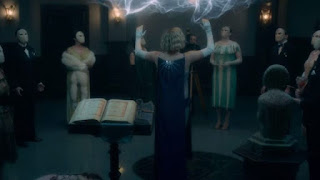
In 'Joan is Awful' we follow the character of Joan (Annie Murphy) who, with her distinctive white streaks in her hair is head of something or other at a large tech company. She has a bad day: she has to sack a colleague, sings in the car going to work, drops a cigarette on said colleague as they leave the building ... just a general, normal bad day ...

But when she gets home, she discovers that the streaming company Streamberry (a direct swipe of Netflix, even down to the onscreen visuals and sounds) has a new series on called Joan is Awful, and this follows the life of a lady called Joan, played by Salma Hyack, who looks exactly like Joan, and whose day unfolds in exactly the same way ... even down to secret text from an ex-boyfriend ...

As a result her current boyfriend (or husband, it's not important) walks out on her, she loses her job, and her life becomes more and more a living hell ... and of course the TV show matches this all beat for beat.

It transpires that, when Joan signed up for Streamberry, she ticked the box that said she had read and accepted the terms and conditions, and as a result, Streamberry was allowed to stalk her and to use her life as the basis for a TV show!  Shades here of the South Park episode 'Human CentiPad' where one of the children, Kyle, is stalked by Apple as a result of not reading the Terms and Conditions when agreeing to download the latest iTunes update, and as a result he has actually agreed to be part of a horrendous medical experiment!

Anyway, Joan takes her complaints to Streamberry, but meets a frosty reception as this is all part of their global plans. Salma Hyack is also displeased as they are using her likeness via an AI to make the episodes - and she has no say and gets no fees ... so she and Joan join forces to try and take Streamberry down!

The episode is a brilliant reflection on modern life where we're expected to read many-page terms and conditions online in order to access services, and in reality have little idea as to what we are signing up to. Plus the ruthlessness and cold-heartedness of Streamberry is notable, moreso as Netflix are airing the series, and this seems to not reflect well on them at all ... I guess someone there has a sense of irony or humour after all. I do wish they would agree to pay the writers fairly though :(

The second episode is called 'Loch Henry' and is a complete change of mood and style. Here we're with a young couple Davis (Samuel Blenkin) and Pia (Myha'la Herrold) who arrive at Davis' family home by the Loch, looking to make a documentary about a couple who went missing there years ago. There's various likely suspects, and we soon realise that this time we're in murder-mystery territory as the culprits are revealed ...

I don't want to say too much here as the pleasure in this episode is watching it unravel before you, and realising who and how the murders happened. It's a sad tale, and the ending isn't all happy ...

'Beyond the Sea' is a strange title for a character piece about two astronauts, Cliff Stanfield (Aaron Paul) and David Ross (Josh Hartnett) on a six year deep space mission.

What puzzled me a little about this episode was the time it was set in - apparently 1969 on Earth, but we're in some sort of alternate universe as the two astronauts are in a space station-like craft, and take it in turns to 'connect' their minds with a robotic body back on Earth, who looks and acts just like them, and which, when their mind is in it, carries on their life as though they had never left.

The robotic 'self' seems to be made from some quasi-organic material and 'bleeds' a silver liquid when cut. So when the men visit their wives and family, they can interact and carry on as normal.

This is, until a crazed Manson-like gang infiltrate David's home and viciously kill his family in front of him, objecting to his 'non-human' form.

David slips into depression, as he is now unable to take the breaks he would have done from the tedium of the space craft. But then Cliff has an idea, why doesn't David take Cliff's robot body for some periods ... to give him relief and to try and keep him sane.  Thus David does this, and meets Cliff's wife Lana (Kate Mara) and son. David can paint, which Cliff cannot, and so David persuades him to allow him to continue to visit in order to complete a painting of the house ...

As this is a Black Mirror episode, perhaps you shouldn't expect happy endings, and here where the story goes and how it ends is maybe the darkest the series has delved so far. Ostensibly a science fiction episode, it's actually a very dark treatise on loneliness, death, and the human condition ...

'Mazey Day' follows the life of a papparazo photographer, Bo (Zazie Beetz), who picks up a lead on a celebrity Mazey Day (Clara Rugaard) who has not been seen for two weeks after she left a film set. Bo has been recently disenfranchised by her chosen career when one of her 'subjects' commits suicide ... But the Mazey Day pictures are worth a lot of money, and so she sets out to try and find her, tracing her to a rehabilitation centre.  She and some fellow 'togs' break in, and find that she seems to be being held captive there ... but why?

As always, I'm not going to give the game away, but this is a great horror-based episode, with a neat twist that we certainly didn't see coming ... It's television firing on all cylinders, and giving us science fiction, horror, thriller, drama and everything in between ...

Finally in Season 6 comes 'Demon79', and Brooker's penchant for humour comes right to the fore (the episode is co-written with Bisha K Ali). Nida (Anjana Vasan) is a mild manner worker selling shoes in a department store, and she experiences imagined flashes of extreme violence against some who cross her. She is forced to eat her lunch in the basement, because others have complained of the smell of her spicy food, and one day she finds a talisman, cuts her finger, and accidentally summons a demon Gaap (Paapa Essiedu). Initially appearing as a very horrific vision, the demon realises that if he is going to get anywhere, he needs to look acceptable so pulls an image from her mind as to who to look like. And he chooses Bobby from the band Boney M in the video for their single 'Rasputin'!  Thus he tells Nida that she needs to kill three people in three days or the world will end ... but what will mild-mannered Nida do?  Surely there's some out there who deserve to die!

Thus the stage is set for a very entertaining episode, levened with humour and great characters, and with all the little touches that make Black Mirror so great. I loved Nida watching Sapphire and Steel one evening ... and the use of Bobby off the Boney M video is inspired.

I have loved this season of Black Mirror which again proves that it's one of the best shows on streaming. Every episode presents something new and different and we veer from science fiction to horror to comedy to thriller to drama and back again, and often all of them all at once.  It's inspired and accomplished writing, supported by great performances and direction.  A note too for the design, which manages to make the settings look like the years they're supposed to be - 1979 here in 'Demon79'.

Do yourself a favour and dive in. If you're not keen on a certain episode (we found the very first one in season 1 - about the politician and the pig - to be not to our taste) then go to another as there are sure to be some things here which will inspire and move you.  For me, the best episode remains 'San Junipero', a superior treatise on love and death ... but others may love other episodes.


Sunday, August 28, 2022

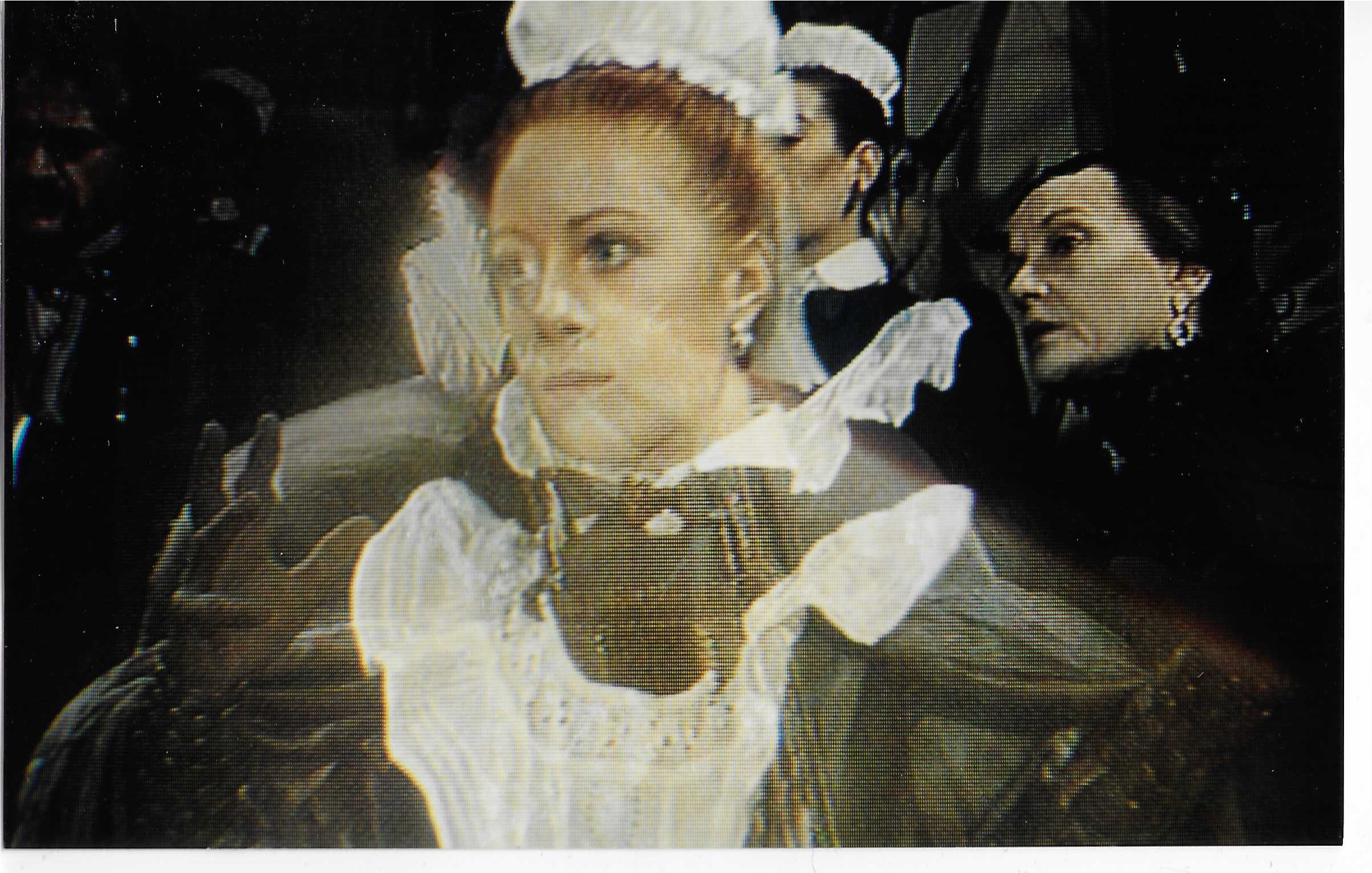
The Curse of the Double Exposure

 Back in the olden days, when television was watched once and then you moved onto something new, there was no concept of being able to watch something again. Unless the BBC or ITV decided to repeat a show, you had one chance to watch it and that was all.  There were no video machines, and so the best you could do was to make an audio recording of a favourite show so you could listen to it again ... but a second best was to take photographs of the television screen.

I was doing both! From around 1974 I was recording DOCTOR WHO on audio each week. My dad had a decent reel to reel setup and he also had the technical knowhow to wire the system into the gubbins from the back of an old television and allow for direct recordings to be made of the tv sound. Some people had to hold a microphone up to the television and insist that everyone in the room be quiet ... but I had no such worries.

Then, from around 1975 I started to get into photography. and by 1976 I was out interviewing Terrance Dicks and Malcolm Hulke for my fanzine. and then in 1977 it was fanzines all the way!! And the first DOCTOR WHO convention in August 1977 paved the way for more photographs and better kit!

Thus I started to dabble in taking pictures from the television set. And it wasn't as easy as it looked! First of all, of course, you had no idea whether what you were taking was actually coming out. A roll of film had to be completed and then sent off or taken to the chemists to be developed and only then did you know if it had worked or not.

Trial and error revealed that you need to slow the shutter speed down. Television (or at least good old 625 line television) is not comprised of a single image. There is a pattern of dots/lines and these refresh themselves every so often, so in order to get a photo of the whole image, your shutter speed needed to be slower than the speed it took the image to refresh.

Also, I discovered that a camera with a SLR system was better - you could actually see the image you were taking through the eyepiece.

Because you had to slow the shutter speed, you also needed a tripod to ensure that the camera was steady, otherwise blurred shots would result. And sometimes, you'd get some photos which were double exposed as you pressed the shutter when you saw a good image, but at that second it changed to a different image ... and you ended up with both on your film!

A recently discovered a load of 'failed' double image pictures from DOCTOR WHO and realised that today, with digital cameras and computers, there was no need to use a camera/tripod/film any more. Any image you want can be taken direct from a video file with a Screen Capture ... and of course you would NEVER get a double image this way - unless the director had done a fast cross fade so there was actually two images on screen at the same time.

So I thought, before I bin them, I'd record these images here. All taken with my SLR camera, on a tripod, poised in front of DOCTOR WHO being shown live on the television ...

I've probably got more somewhere ... so enjoy ... the accidental fruits of the lost art of taking pics of a live television transmission!


Sunday, August 21, 2022

Review: Late Night Horror: The Corpse Can't Play (1968/2022)

Being something of a horror buff, I'm always interested when something new appears ... and so I was fascinated when I saw online that the archive television preservation organisation Kaleidoscope were releasing an episode of a TV horror series previously unknown to me ... Late Night Horror. This was a 6 episode series, made in colour (very early for that) for the BBC in 1968, and then repeated once in 1970. All the series was lost (due to the BBC's policy of wiping tapes and destroying material which was felt to have no further commercial value) but a single episode was discovered in a private collection back in the 1980s, but then vanished into another collection, only to emerge again in 2016, where Kaleidoscope bought it, and restored it.

Now they have released it, along with a short book looking at the history of the show, and it's a fascinating glimpse of this series.

Continuing the theme of the restoration, what was recovered was a black and white film print, but technology and some brilliant minds have managed to use colour information recorded on the frames of the print to regenerate and recreate the colour ... add many, many hours of manual work retouching and repairing faults on the print, and you have something which could be transmitted again today - it's actually quite incredible!

The episode which has been recovered is called 'The Corpse Can't Play', written by John Burke, and is a neat little vignette set at a kids' party where the adults prepare sandwiches and cake while the kids run riot around the house, shouting and screaming and pushing and shoving. A latecomer is 'Simon' who brings the best present, but who is then tormented by the birthday boy ... and the ultimate results are quite horrific.

I enjoyed seeing it a lot, and it actually brought back vague memories of the tale. I would have been 7 years old in 1968 so I doubt I saw it then, and nor in 1970 ... but perhaps I am remembering the story from a print appearance - several of those adapted saw light in The Pan Book of Horror Stories and the original story, 'Party Games', was in The Sixth Pan book of Horror Stories (1965) ... so maybe that's where I know it from ... not sure.

The package from Kaleidoscope is available here: https://www.tvbrain.info/shop/books/late-night-horror

This includes a DVD of the production (plus a feature on the restoration and a rather nice trailer for the series featuring Valentine Dyall as 'the Man in Black') and the book.

While the book is a welcome addition, they really need to pay more attention to the layout which is very sloppy and brings the whole thing down a notch in my opinion. I think, personally, I would have preferred a presentation in a DVD case, with the DVD there, and the book sized to fit inside the case too ... But that's me being mega-picky.

As a piece of historic television, this presentation is to be applauded, and I hope that other horror series could be found and restored to this quality ... Well worth a look if you're interested in television horror!


Here's the titles for the show ... in black and white and from a BBC Radiophonic Workshop demo reel. The music is by Dick Mills and appeared on the BBC LP Out of this World.


Sunday, January 23, 2022

Review: Archive 81

There's a lot of material on the streaming services these days, so when something appears which is actually really good, it's worth shouting about.

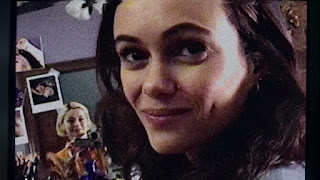
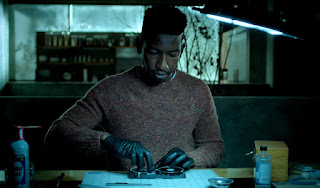
Netflix's ARCHIVE81 is such a show! It's an 8 part, hour long set of episodes, chronicling the story of a man named Daniel (Mamoudou Athie) who is hired by Virgil Davenport (Martin Donavan) of a company called L.M.G.to salvage and preserve a set of Hi8 video tapes recorded back in 1994 by a woman named Melody (Dina Shihabi) ... it's all tied in with an apartment building in New York called the Visser which was destroyed by fire, and what happened to Melody at that time ... As Dan digs deeper, so he finds himself reliving Melody's nightmare as she investigates the Visser for an oral history of the place as part of her PhD. She records everything on her video camera and so it's all there to be salvaged and played back in the present day.

The strangeness starts to emerge as Virgil seems to know that Dan's family was killed in a fire when he was a child, and also that Dan must work out of a deserted facility in the middle of nowhere ... with no contact with the outside world. Dan's father appears on Melody's tapes proving that he's somehow involved in it all ... and a young girl, Jess (Ariana Neal) who helps Melody make contact with some of the apartment's residents also seems involved somehow.

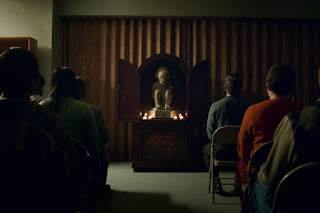
As the episodes progress we're introduced to a strange cult operating out of the Visser, worshipping an ancient icon, and using an unnerving aural chant to invoke a fugue-like state ... And the mystery piles on as more people are introduced, including a present-day Melody who turns out to be an impersonator, Melody's friend Annabelle (Julia Chan) starts drawing images of a mystery-woman who turns out to be the original leader of the cult ...

I'm not going to say much more as the complexity and twists and turns of the production are one of it's strengths. It's got a great structure, with Dan in the present day looking back at Melody in 1994, and Melody in turn is seeing things from 1924 ... it's something of a crash of years and ideas as this icon-worship has persisted through the years and forms a backbone for the narrative.  Another strength is the sound design - and as part of the ritual is a strange humming cadence, this is used, along with a simple yet chilling note sequence in the music and sound design, so that the whole production becomes permeated with dread and horror as you watch. It's very clever.

The show is based on a podcast, also called Archive81, which can be found on Apple Podcasts (https://podcasts.apple.com/us/podcast/archive-81/id1098194172?mt=2), and all major podcast apps. The Archive81 Wiki explains that it's a found footage horror podcast created by Dead Signals about ritual, stories, and sound. It describes the Podcast thus: After Daniel Powell goes missing following employment by the Housing Historical Committee of New York State, his friend Mark Sollinger receives hundreds of hours of audio of his archiving there. The audio, released by Mark in the form of the podcast, documents Dan's listening to an extensive collection of cassette tapes, containing interviews from a high-rise apartment building in 1994. So it certainly has a similar background to the TV show.

I found the show totally engrossing, and very creepy. As Dan listens and watches the old tapes back, alone and isolated in this strange compound, so we visit 1994 with Melody ... and when Dan and Melody actually meet and interact, then you know that some deeply weird stuff is going down here ... each episode brings something new, and the nightmare deepens the farther you get.

If I had one complaint, it is that I would have given the last half hour or so a good script polish as there are elements there which just leave questions hanging as to what actually happened, and you don't want that after 8 hours of great drama.  It's telling that there's already an article on DigitalSpy explaining the ending, and the search is also one of the selections on Google - it seems a lot of people felt the same way as I did ... what did happen?  And that's not really what you want.


Sunday, August 01, 2021

Review: The Water Margin

Everyone of a certain age probably remembers The Water Margin ... it was an hourly serial shown on Saturday nights around 1976, and immediately before BBC2's popular double bill of horror films ... 

I suppose it's popularity arose out of the fever for 'Kung Fu' and all things oriental around that time ... popularised by the films of Bruce Lee, and David Carradine as Cain in the TV series Kung Fu ... but this was something slightly different.

Indeed, this was a 1973 Japanese production of a 13th-century Chinese epic by Shih Nai-an of a group of 'knights' who rose up against a corrupt government and overthrew it ... The original Japanese series was picked up by the UK, and translated into English by David Weir ... but not subtitled ... no, the original cast were dubbed into English ... and what was clever, was that they didn't worry about an exact translation. They looked at the lip movements and tried to match English dialogue to it, so that the whole thing came across as more naturalistic than a direct over-dub ...

It was wildly successful, and the series lived on in the memories of all who saw it. Now the whole series is available on DVD ... and it's the English dub that we all know and love ...

'Do not despise the snake for having no horns,' says Bert Kwouk at the start of each segment. 'For who is to say it will not become a dragon!' ... and thus the story is told.

Basically it's the tale of Lin Chung (Atsuo Nakamura), a captain in the Emperor's Guard, who is disgraced by the scheming Kao Chiu (Kei Satō) as he wants Lin Chung's wife, Hsiao Lan. And so he has her, and then banishes her also. Lin Chung is dragged off in chains across the desert, and eventually winds up at Liang Shan Po, a watery district far to the south of the Capital city. There he finds friends and starts to build a community which will eventually rival the government.

Along the way there are others who join the fight. Legend says there are nine dozen heros - 108 - who will fight ... and we follow the paths of some of them as the series progresses. Chief among them is Lin Chung, but also the female warrior Hu San-Niang (Sanae Tsuchida), Lu Ta (the Priest) (Isamu Nagato), Yang Chih (Blue Face), Wang Lun (Yoshirô Kitahara), Wu Sung (Tiger Hunter) (Hajime Hana), Shih Chin (Tattoed Dragon) (Teruhiko Aoi), Chu Wu (Ryôhei Uchida), Sung Chiang (the Good Judge) (Takeshi Obayashi), Li Kwei (Black Whirlwind) (Hitoshi Omae) and others ... all have parts to play in the drama. The cast is all over the place online with spellings different to those on the box set ... so please excuse me from not crediting them all!

What is good about The Water Margin is that it never gets boring ... everything moves along at pace and there are fights and battles along the way, and characters you like and can relate to. Lin Chung is essentially a good man, a man of peace, and so even at the end of the second series, he is reluctant to just kill Kao Chiu, preferring to let 'nature' have it's way ... but the series still ends on a good note ...

As enjoyable television, the show is superb, combining some great performances, both on-screen and verbal, amidst fast and furious action. The music is great also!

The English cast are mostly uncredited, but here is what I have been able to discern:

Michael McClain (Lin Chung), Miriam Margolyes (Hu San-Niang), Peter Marinker, Sean Lynch, David Collings, Simon Lack, Elizabeth Proud, Michael Kilgarriff and Trevor Martin. David Collings is fairly easy to spot as he also provided the voice for Monkey in the similar series of the same name, but others less so.

Here's a piece on the dubbing process: https://www.bbc.co.uk/archive/dubbing-the-water-margin/zvmft39

And that brilliant theme and titles: https://www.youtube.com/watch?v=TVVRMBWGBqw

Wednesday, June 02, 2021

Review: Monkey

What a strange and memorable series Monkey is ... I'm sure many readers of a certain age will recall the adventures of the Buddhist Priest Tripitaka (Masako Natsume), and his travelling friends Monkey (Masaaki Sakai) (a monkey God), Sandy (Shiro Kishibe) (a fish spirit) and Pigsy (s1: Toshiyuki Nishida, s2: Tonpei Hidari) (a pig spirit), along with (in the second season) Dragon (Shunji Fujimura), a horse which can turn into a human ...

We've just finished rewatching the entire series, and so I felt a few words of review were in order.

The show originated in China, along with its soul mate, The Water Margin. Whereas The Water Margin was for adults, with more serious plots and storylines, Monkey was definitely for kids. It had lots of fighting, demons who were basically humans wearing furry hats and make-up, and who often as not had horns on their heads, and plots which presented the simplest of moral challenges for the protagonists.

Series One is the better of the two. Here, it all seems to take itself more seriously, and the actor playing Pigsy is better (he changes for Series Two for no apparent reason).

Why the show succeeds is in the dubbing into English. As with The Water Margin this was undertaken to try and match the words to the characters' lip movements, rather than being a literal translation of the dialogue. Thus it all seems to work, even if what they're saying isn't what was intended. This all reminds me of the dubbing of The Magic Roundabout, where the original French soundtrack was scrapped, and it was given a new English narration based on what the writer thought the story was about, rather than what it actually was. I have no idea if any episodes of Monkey ended up being about something completely different, but it's amusing to think they did.

Another thought that struck me was how the series prefigured all the Power Rangers shows, which also have a band of heroes fighting monsters and demons, many of whom have outrageous costumes and make-up ... there are a lot of parallels.

The English Dub actors for Monkey were as follows: Monkey: David Collings; Tripitaka: Maria Warberg; Sandy: Gareth Armstrong; Pigsy: Peter Woodthorpe; and Horse: Andrew Sachs.

You may notice that the monk Tripitaka, is voiced by a woman ... well he's played by one as well (Masako Natsume) ... but no-one ever comments or suggests that the character is anything but a boy! It's the British Pantomime tradition alive and well!

When we move into Series Two, several things change. The titles are different, and not as good. The closing title music is different, and not as good. Pigsy is played by a different actor, who is not as good, and indeed Peter Woodthorpe seems to give a different vocal performance to the character, again which loses much of his charm. Overall the show becomes sillier, more one-note and less compelling. The stories are all samey and generally involve a village being terrorised by Demons which the group have to try and defeat ... It's a shame really as the series still had much potential which was unfulfilled.

One thing I really enjoyed were the visual effects. Generally speaking, every panoramic longshot of mountains or lakes or whatever were models, with tiny figures of the characters in them, and the effects of Monkey on his cloud, spinning through the sky, and other such visuals, are superbly realised. There are such a lot of them too - the effects budget must have been quite high for the series.

There's surreal episodes too, like one where a small child has toothache, and so Monkey reduces himself in size so he can enter the boy's mouth and beat up all the decay who are singing songs as they attack the enamel! The effects here are again tremendous, and the sets and costumes suitably strange.

Overall, Monkey is a fun little series, which benefits from a rewatch. It's not quite as good as perhaps we remembered, but it has lots to commend it.


Saturday, October 03, 2020

Review: Orphan Black

Every so often a series comes along which is so compelling, that it just drags you with it. We first caught Orphan Black on telly - I forget which channel. It might have even been on Netflix, though I don't think it was. We watched to the end and were enthralled throughout. So much so that for Christmas last year I got a well-priced Box Set of the series, and we have just finished watching it all again!

So what is Orphan Black? It's a thriller series, but one which takes as it's basis and background the ideas of clones and DNA and genetic manipulation and longevity. So there's Big Science involved, and mysterious organisations (the Dyad Institute and Neolution) and powerful men controlling these structures.

Into this world falls Sarah Manning. In the opening episode, Sarah is standing on a train platform waiting for her train. She's a bit of a rebel, a bit of an outlier of society. Down from her on the platform is another girl. She seems agitated, and when she turns to look at Sarah, she has the same features - she is Sarah's double. She places her bag on the platform and abruptly steps off in front of a train and is killed!

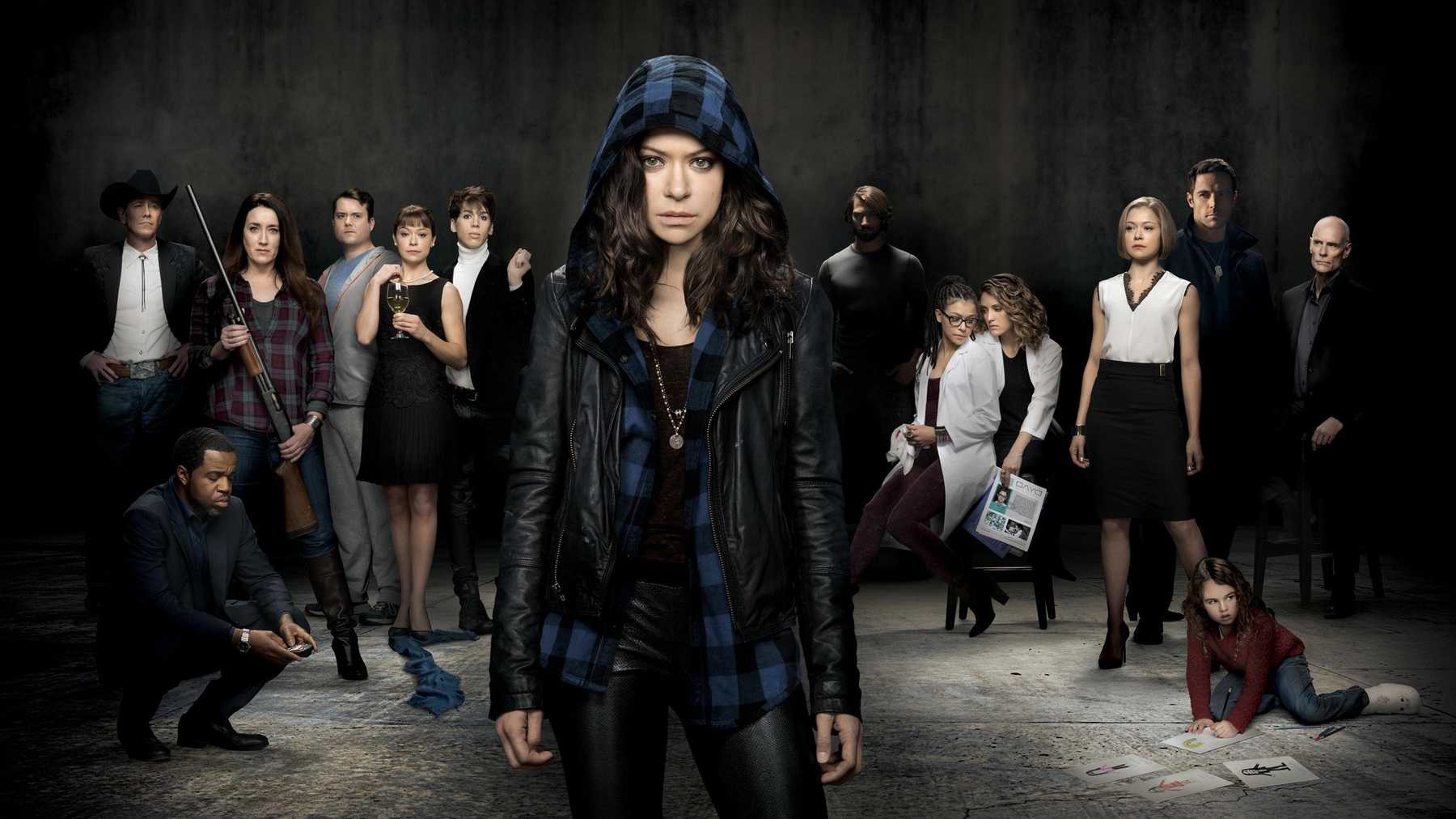
Sarah is shocked, but, ever the opportunist, she steals the girl's bag as she leaves. She discovers that the girl was Beth Childs, a policewoman ... and from this point Sarah's life is turned upside down. She learns that Beth was a clone, and that there are other clones too: blonde Helena is a twisted and insane version of herself; Alison Hendrix is a soccer mom living in a perfect home with a perfect husband, Donnie (Kristian Bruun), and two adopted kids; Cosima Niehaus is a science nerd, studying hard genetics and DNA to try and find a cure for the respiratory disease which threatens to kill her ...

All these characters clash together, along with Sarah's brother Felix (Jordan Gavaris) (they were both adopted by the same mother, called Mrs S (Maria Doyle Kennedy)) and discover that they are all part of a global conspiracy to control birth and genetics and sell it to the highest bidder.

So that's the basic set-up, and each season follows and develops the ideas and concepts and keeps opening the show up.

In season One Sarah assumes Beth's identity to try and find out more about her and discovers a hidden world of clones and corporate espionage. Someone is also killing the clones, one by one, and the race is on to find out who ... Sarah's daughter, Kira (Skyler Wexler), is also the focus of intense interest of Aldous Leekie (Matt Frewer) who runs Dyad as Sarah (and Helena) are the only clones who are fertile.

In Season Two we are introduced to clone Rachel Duncan, who is high up in Dyad, and Delphine (Evelyne Brochu), a Dyad scientist who works with, and falls in love with Cosima as they try to find a cure for her illness. Meanwhile Sarah is trying to stay alive while Alison is trying to lead a 'normal' life in the suburbs but ends up killing one of her 'perfect mom' rivals.

Season Three brings in the idea that as well as Sarah and her clones (termed Leda) there are also Male soldier clones (called Castor) (Ari Millen) and Sarah must discover what and why they exist. We meet another Leda clone, Krystal Goderich, and Cosima meets and falls for Shay (Ksenia Solo) who may or may not be another spy ...

Season Four fills in backstory with Beth investigating what is going on, and the discovery of Neolution's plan to implant tech worms in humans to harvest and control their DNA. Meanwhile Helena is being held captive, and the Neolution cult, headed by the aged P T Westmoreland (Stephen McHattie), has a base on an island where Cosima is being forced to conduct experiments ...

Season Five brings it all to a close, with Dyad and Neolution being attacked by the Clones ... but will there be a happy ending? Will Sarah and her sistres survive, and how will the world look in the aftermath.

I have deliberately tried to avoid spoilers in this brief rundown, and really the show is far more involved and engaging than it's possible to explain in a review. Furthermore, sharp eyes will have spotted that I have mentioned no actresses for Sarah and the clones. This is because they are all played by the same actress, Tatiana Maslany, who is simply a revelation and utterly the best thing about the show. Every one of her characters is different, from the way they dress, through their speech and even the way they move and react. You always know exactly which you are watching, and even when one clone has to pretend to be another (which happens a fair amount), Maslany manages to imbue her performance with aspects of both. It's a brilliant performance! And her depiction of the feral and unpredictable Helena is simply a joy. 

Furthermore, the direction and technical skill on display is immense as we often see several Clones together in the same shots, same scenes. The effect is flawless and you totally believe that these characters are separate and different and, indeed, are all together partying or talking or whatever. It's actually hard to believe that they are all the same actress, it's that good! There's little wonder she won the Primetime Emmy Award (2016), a TCA Award (2013), two Critics' Choice Awards (2013 and 2014), and five Canadian Screen Awards (2014–18).

Another pitch perfect element of the show is the title sequence and accompanying music. The music especially is so hauntingly memorable and builds beautifully over its short span, but this is enhanced by the visuals which encapsulate perfectly the themes of the show. There's DNA strands and separation of an egg, two 'Sarahs' split away from each other ... it's a magnificent piece of work in its own right. It is no surprise that Technicolor's Design team won an Applied Arts Award for the opening title design.

If you gather that I am a fan of the show, then you'd be right. Supporting Maslany in her multiple personas is a company of simply superb actors. Kudos to Jordan Gavaris as Felix, who manages to be the rock that Sarah clings to, while all the time being big brother to Alison and Cosima, while navigating his own sexuality through painting in the nude! He is a superb character, and very well played. Then there's Maria Doyle Kennedy as Mrs S, a towering performance of a mother who will do anything to protect her kids, even when she's more involved than she would like to admit. Kevin Hanchard plays Art Bell, Beth's partner in the police. He has a struggle to accept what's happening, but turns out to be a powerful ally. Even minor parts are cast and performed well, making the whole show one of the most watchable and enjoyable that I have ever seen.

If you get a chance to watch it, then do so. If you like spy thrillers, conspiracy shows, and action/adventure then I don't think you'll be disappointed.


For further reading there's a great piece on the show here: But Beware Spoilers!


I just found too this SDCC panel where the cast are challenged to perform against different clones with Maslany playing all of them!

Monday, July 20, 2020

Review: Warehouse 13

Every so often a show comes along which is a little more special and different from those that have gone before. Indeed, these often spawn imitators which use some of the ideas in a perhaps more cliched manner.

I can't remember when I first stumbled upon Warehouse 13 ... I remember seeing odd episodes  on the schedules, but not watching them, and I think I was aware that it was co-created by Jane Espenson who I knew from her work on Buffy The Vampire Slayer.

Eventually I think we stumbled across a repeat run and this time, it engaged and we watched the show right through, and loved it so much that I bought a DVD Box set of all the episodes to enjoy again ...

So what's it all about ... Like all the best shows it's curiously simple in concept. There is a vast warehouse, and this is Raiders of the Lost Ark type warehouse, but pretty much infinitely large. It's entrance is in what seems to be a quarry in South Dakota, but beyond the entrance, the Warehouse extends under the mountain range behind. Within this Warehouse are held 'artifacts', and each episode usually revolves around the use, retrieval or discovery of these objects. An artifact is created when the owner does something particularly special, artistic, creative, brave, cowardly or any other strong emotion. The object is then imbued with a 'power' which is related to that emotion or achievement. So there are artifacts which make you invisible, which can make you fly, can cause earthquakes, drain your energy, change your sex ... you name it, there's an artifact which can do it. If you're interested in a list of them all, then there's one here: https://warehouse13.fandom.com/wiki/List_of_Artifacts_and_Gadgets

What I particularly like is that they are all very imaginative in their construct, playing off the particular real-life characters and their achievements. For example, there's Lewis Carroll's looking glass - a large mirror which traps the insane 'Alice' behind it. It also seems to house an alternate dimension (you can play ping pong with yourself through it) but you can also swap places with the insane Alice who then can emerge, looking like you!

All these objects form the core of the show, and one thing I really like, is that all the way through it never really loses the 'episode by episode' format. I have talked about this in relation to other shows, where somewhere in season 2, they stop being about the stories, and start to become about their own internal logic and characters, which basically means that unless you've watched them all, then the episodes are unwatchable in isolation or out of order.

With Warehouse 13, yes as the seasons progress, there is more and more revealed about the Warehouse. That Number 13 is the current (and 13th) incarnation of it. That it can move about. That there are 'Regents' who monitor what's happening, and a single 'caretaker' in charge at any one time ... and there can only be one 'caretaker' at any time. There's plots involving H G Wells (who in this universe is a women, Helena, who gave all the ideas to her brother ...), saboteurs out to get the Artifacts, incursions by Knights Templars, and finally a plot to 'steal' the whole warehouse through various time travelling shenanigans.

As you can hopefully see, the series' concept and set up is wide enough to encompass tales set in any age, in any time, and with many interesting sidesteps along the way: there's a black and white episode; one which is a computer game;  one which features a past Warehouse, and even one which takes place in a Spanish Soap Opera!

Core to any great series is a good set of characters, and Warehouse 13 manages this seemingly effortlessly. In charge of the Warehouse is Artie (Saul Rubinek), an older man, gruff and shabby, but very smart. As the series starts, two new agents are recruited to join the Warehouse to help in the retrieval and cataloguing: these are Pete Latimer (Eddie McClintock) and Myka Bering (Joanne Kelly). Pete and Myka have a great will-they-won't-they relationship, and their interplay is always a pleasure to watch. They have a lot of fun!

Joining them slightly later on is Claudia Donovan (Allison Scagliotti), a younger girl with 'history' who is a hacking and computers expert.  I actually think Claudia is perhaps the best character, and Scagliotti plays her with such energy and verve ... she is the series' 'manic pixie dream girl'.

Later on there's another agent, Steve (Aaron Ashmore), who joins. Plus there's the 'caretaker' (CCH Pounder) who comes and goes as she does, and the Regents, of which Valda (Mark A Sheppard) is the most notable ... H G Wells (Jaime Murray) of course, and also significant guest roles for Anthony Head, Rene Auberjonois, Lindsey Wagner, Roger Rees, Kate Mulgrew, Jeri Ryan, and many other names familiar from other genre shows.

Overall the experience of watching is a hugely enjoyable one. I like the mix of drama with comedy, and the interplay between the characters is a delight. You come away with the impression that everyone had a great time making it, and this enjoyment spills over into the characters and onto the screen.

It's worth noting too, that the show does actually have a proper ending, even if the final episode feels a little 'tagged on' ... I guess we can forgive them for wanting to do that, as without the conclusions for all the characters, the whole thing might have felt a little empty. I particularly love the final scenes where Claudia ... but that would be telling!

If you've not seen it, then give it a try ... as I say, the structure is such that probably most episodes are accessible if you understand as much as I've tried to explain here, but as with all shows, if you can start from the beginning, then you'll get loads more out of it.


Saturday, April 11, 2020

Review: Star Maidens

I'd never seen Star Maidens before ... odd probably ... but I recently nabbed a DVD set of all the episodes for a peruse.

It's a strange beast indeed. First of all, the title is something of a misnomer ... it was made in 1976, and I guess that women in power was a bit of a 'thing' then ... so the basic idea is that there's this planet called Medusa which is ruled by women. The men are kept as slaves and breeding stock ... and thus is life there. In fact, life seems to consist of wandering aimlessly around a sort of three-level complex as that's all we see.

The planet of Medusa is inexplicable blown out of orbit of it's sun and off into space, where it ends up close to Uranus (stop giggling at the back) from where it can send ships to and from Earth. The closest the two get is 1.6 billion miles (2.6 billion kilometers), and based on 'normal' speeds, the Voyager 2 spacecraft was launched on Aug 20, 1977 and it reached Uranus on Jan 24 1986. So, Voyager 2 took almost nine and a half years to reach Uranus. But we need to gloss over this for the sake of our sanity.

The basic plot of the series is that two Medusian men, Adam (Pierre Brice) and Shem (Gareth Thomas), steal a ship and escape to Earth where they hide out. Meanwhile two humans, Dr Rudi Schmidt (Christian Quadflieg) and his assistant Liz (Lisa Harrow) are taken to Medusa.  Henceforth the episodes flip between Earth-bound stories involving Adam and Shem, and Medusian-based ones involving the humans in the alien environment.

To be honest, the Medusian-based ones are much better. The Earthbound stories feel like very low budget affairs, perhaps poor relations to much better series like Ace of Wands and The Tomorrow People. But those on the alien planet have some thought and concept behind them, even if it all gets a little samey.

I was surprised to see Ian Stuart Black writing a large number of episodes (you may know him from his Doctor Who work on 'The Savages', 'The War Machines' or 'The Macra Terror'), and also Freddie Francis directing (the same guy who earlier directed films like Doctor Terror's House of Horrors and Dracula has Risen from the Grave!).

Despite this, the show struggles but never really rises above mediocre. There's none of the panache and sheer narrative and production excellence which made Doctor Who or Ace of Wands sing at the time. I wonder if it's because it's a German co-production, and that there was some behind the scenes conflict as to what sort of show the various companies wanted to make. Is this a comedy or serious SF, a kid's show, or something a little more intellectual ... the show veers between all of these with no real answer.

The cast should be great, with Gareth Thomas a couple of years away from his defining role as Blake in Blake's 7, Judy Geeson as Fulvia, Adam's Mistress, and bond girl Dawn Addams as Clara, the Medusian leader ... there's even a cameo from Alfie Bass (playing the caretaker of a Castle) of all people!  But there's also some German actors who seem less comfortable with the material ... and the overall impression is of something of a mess.

It's a shame as conceptually, the show echoes Space 1999, and has touches of Blake's 7 and The Tomorrow People ... The visual effects were done at Bray - home to the Anderson shows, and the quality of the miniature work is excellent as a result.

The stories are okay, but patchy, and even the final episode which introduces an enemy for the Medusians called simply 'the Enemy' - some creature whose face and head we never see, but who has three fingers Sontaran-like, and who seems to be controlled by some computer thing - fails to really resolve anything, and yet sets up for perhaps more stories and adventures to come ... but it was not to be!

As a science fiction curio from the seventies, it's worth checking Star Maidens out ... a fun series which is better than you expect it to be, without being truly outstanding.

And, astonishingly, and assuming they're not clever fakes, there seem to have been some Star Maidens action figures/dolls released!  Amazing!  I also noted some jigsaws and an Annual too ...