Welcome to the homepage for author and publisher David J Howe. I'm the author and co-author of numerous books about the TV Show "Doctor Who", as well as being a freelance writer and Editorial Director of Telos Publishing Ltd.
If you'd like to comment on any of my musings, then just click on the 'comments' word under the post, and then on the 'Post a Comment' line under the post on the next screen.
Lucio Fulci may be better known for his zombie fare, but he has made far more films than that, and this offering from Arrow is a Poe adaptation which was made between the heady rotting delights of Zombie Flesh Eaters and The Beyond.
It's not a bad film, but suffers a little from a lack of clarity around what is actually happening. There's a black cat (of course) which seems to have a propensity to attack those around it, scratching hands and faces and causing maximum damage for very little provocation. I think I would have had the beast tracked down and put down to be honest, but here it wanders through the plot with scarcely anyone paying it much attention until it attacks them.
The main thrust of the film follows Patrick Magee as Robert Miles, a college professor and medium. He seems to be being stalked by the cat of the title, and indeed, the creature is killing people in interestingly and slightly supernatural ways ... so Magee does indeed catch the cat and hangs it, but this then unleashes more supernatural shenanigans. In fact, Magee is a bit of a creep here and tries to hypnotise American Tourist Jill (Mimsy Farmer) which fails due to feline intervention, and who then kidnaps her and walls her up in his house (a typical Poe trope). She is found when the police hear a cat crying and discover that it has been walled up with Jill ...
There is a strong film here struggling to escape from the script which is vague and meandering, and perhaps is showing a few Giallo roots wherein atmosphere and event takes the place of plot and progression (ie things happen for apparently no reason). Which is a shame as Fulci does a good job of piling on the atmosphere and Magee is excellent in the lead - his voice is very creepy and adds a lot to the feeling of dread that the film starts to build up.
The print from Arrow is very nice indeed, with good colours and great clarity, which makes viewing the film even more pleasurable. It's just a shame that the script is a little too shakey.
Among the extras are a couple with Film Historian Stephen Thrower who discusses the film and visits the locations. The location piece is actually lovely, and it's nice to see the 'then and now' comparisons, but someone should have told Thrower not to say 'Errm' every second. It's so jarring and is very distracting. On the studio-bound discussion, I notice that he seems to be cut every couple of seconds, perhaps to remove the majority of these 'Errms' and 'Arrrs'? But some still remain. A shame as he seems very knowledgeable about the subject ... but not a natural performer for camera.
A final note: the DVD set from Arrow also contains the film Your Vice is a Locked Room and Only I Have the Key, but this was not provided for review.
LIMITED EDITION CONTENTS:
Limited Edition boxed-set (3000 copies) containing Your Vice Is a Locked Room and Only I Have the Key and The Black Cat
Brand new 2K restorations of the films from the original camera negatives
High Definition Blu-ray (1080p) and Standard Definition DVD presentations
Original Italian and English soundtracks in mono audio (uncompressed PCM on the Blu-rays)
Newly translated English subtitles for the Italian soundtracks
Optional English subtitles for the deaf and hard of hearing for the English soundtracks
Limited Edition 80-page booklet containing new articles on the films, Lucio Fulci’s last ever interview and a reprint of Poe’s original story
YOUR VICE IS A LOCKED ROOM AND ONLY I HAVE THE KEY:
Through the Keyhole – a brand new interview with director Sergio Martino
Unveiling the Vice – making-of retrospective featuring interviews with Martino, star Edwige Fenech and screenwriter Ernesto Gastaldi
Dolls of Flesh and Blood: The Gialli of Sergio Martino – a visual essay by Michael Mackenzie exploring the director’s unique contributions to the giallo genre
The Strange Vices of Ms. Fenech – film historian Justin Harries on the Your Vice actress’ prolific career • Eli Roth on Your Vice and the genius of Martino
Reversible sleeve featuring original and newly commissioned artwork by Matthew Griffin
THE BLACK CAT:
Brand new audio commentary by filmmaker and Fangoria editor Chris Alexander
Poe into Fulci: The Spirit of Perverseness – film historian Stephen Thrower on Fulci’s Poe-tinged classic
In the Paw-Prints of the Black Cat – a look at the original Black Cat locations
Frightened Dagmar – a brand new career interview with actress Dagmar Lassander
At Home with David Warbeck – an archive interview with The Black Cat star
Original Theatrical Trailer
Reversible sleeve featuring original and newly commissioned artwork by Matthew Griffin
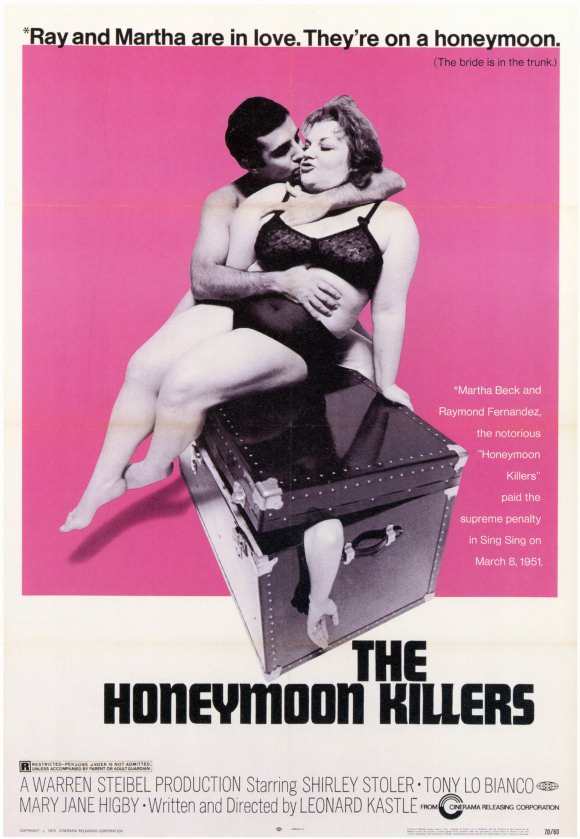
Based, albeit somewhat loosely, on the famous real-life story of the so-called ‘Lonely Hearts Killers’ Raymond Fernandez and Martha Beck, who in the late 1940s murdered a number of women whom Fernandez seduced through a correspondence matchmaking service with a view to stealing their savings, The Honeymoon Killers is a unique film in many ways – at least, I don’t think I’ve ever seen another quite like it.
Shot in stark, documentary-style black-and-white, on a paltry budget of $150,000, this was the first film to be made by its stars Tony Lo Bianco and Shirley Stoler, all of whose previous acting experience had been confined to the stage; the first to be produced by television current affairs programme-maker Warren Steibel; the first to be written and directed by Steibel’s friend Leonard Kastle, who was actually a composer by profession; and the first to be shot by cinematographer Oliver Wood. In fact, Kastle was the third choice as director – the first was a young Martin Scorsese, just starting out on his career, who was fired by Steibel for working too slowly, although the small amount of material he oversaw was retained in the final edit.
The rookie status of the film-makers and the impoverished nature of the finished production means that, at times, it almost has the look of a student film project. Apparently the actors had to do their own hair and make-up, as no professional input could be afforded for this; and another pointer to the lack of finance is that, instead of a specially-composed score, the soundtrack is comprised of sections from two Gustav Mahler symphonies – the use of which, it must be said, becomes a little over-the-top and distracting at times.
However, in spite of, or perhaps because of, its poverty row trappings, the end product is strangely effective and compelling. There is a cold brutality about the way the couple’s killings are depicted, and it is no surprise to learn that at the time of its release, it was seen as an ‘exploitation film’; indeed, it was banned in Australia until the late 1980s. Over the years, however, The Honeymoon Killers has certainly acquired plenty of admirers – famed French director Francois Truffaut once famously described it as his favourite American film – and reassessing it courtesy of this new Arrow Blu-Ray release, it is easy to see why.
Blu-ray presentation
Arrow have handily packaged the Blu-Ray along with a DVD of the film (not seen for this review), making a very nice dual-format release. With a brand-new 4K restoration, the quality of the Blu-Ray picture is excellent, as is that of the original, uncompressed mono audio. There is also a generous offering of well-presented extras:
•Love Letters, a video piece by Robert Fischer featuring actors Tony Lo Bianco and Marilyn Chris and editor Stan Warnow.
•Folie à Deux: Todd Robinson, director of the 2006 remake Lonely Hearts, explores the true story of the Lonely Hearts Killers.
•Body Shaming: Todd Robinson discusses the film.
•Beyond Morality: Fabrice du Welz, director of the 2014 Belgian-French film Alleluia, explains how The Honeymoon Killers inspired him.
•Reversible sleeve featuring original and newly-commissioned artwork by Jay Shaw.
•Illustrated collector’s booklet (not seen for this review) featuring an extensive new essay by horror author and researcher Johnny Mains on the film and its real-life inspiration, plus archive materials.
I was shocked when I realised that I'd not actually written and released a book since 2011, when my horror fiction collection talespinning came out from Telos. Time has a way of getting away from you ...
I have suggested a few titles to the BBC over the years, but unfortunately they seem to be running something of a closed shop at the moment, and anything coming in from 'outside' seems of no interest to them ... which is saddening ... but it also means that trying to do something good and cool with images and artwork is way out of the scope of an independent press - it all costs a lot to clear and to print, and then sales can be very hard to come by too - it's like a game of roulette ... you might succeed, but all the odds are all stacked against you.
Then, in May this year (which is 2015) I had an unexpected and massive heart attack, which brought me literally down to earth. I couldn't work, I couldn't really do much at all except recover. And that meant sitting around a lot and doing very little except watch television and watch the grass growing in the garden.
So, in an attempt to alleviate boredom, I decided to re-watch some Doctor Whos ... I started with Hartnell, and worked my way through the first season before getting a little restless ... there's not many monsters there you see, and the historicals have never been to my taste ... so I then skipped to all the available Troughtons and loved seeing those again ... and then I wondered whether to continue with Pertwee or move to something else.
I then considered that I had reviewed all the NuWho episodes from 2005 onwards on my Blog, and that here was a great opportunity to watch them all again, and to see if I agreed with what I had said at the time ... and what a great idea for a book! Something which looked at Who as it was transmitted, and then was re-evaluated based on a current viewing. So that's what I did.
Starting with 'Rose' with Christopher Eccleston, I re-watched them, in order, and took in some of the special mini-episodes as well if they seemed relevant to the overall television 'story' of the show.
It was fascinating to see how the series developed, year on year, with Doctors and Companions coming and going ... Interesting to see how the Soap Opera elements which were prevalent at the start, lessened, and how the story arc idea, strong at first, again lessened.
The first volume of reviews, which I decided to call Then and Now, goes up to the end of the David Tennant era, as that seemed to be a good cutting off point. Plus, the book was getting too long! The second volume will cover the Matt Smith and Peter Capaldi episodes ... and will be published at the very end of 2017, following Capaldi's final episode at Christmas.
I am currently up to the start of Peter Capaldi with my re-watch, and it's again been interesting to see overall what an impact Steven Moffat has had on the show during the Matt Smith years, with the narrative coherence slowly dropping away, and continuity, event and introspection taking the place of actual plot and adventure. Not that I see this as a good thing ... for me, the plot and 'adventures in time and space' and monsters have always been the prime focus of the show ... and the inner lives of the Doctor and his companions don't interest me ... but there you go.
I'm still enjoying the show, and like the occasional flashes of brilliance that it shows. I wish it could be more coherent and more consistent, but for that I suspect we need another sea change in the running of the show, bringing in fresh ideas and eyes to carry it forward.
For the moment, as I write this, we are in the middle of Capaldi's second season ... and I'm wondering if my opinions of these episodes will change between viewing them now, and then re-watching them in a few months time ... We shall see!
Then and Now Volume 1 is now available to order direct from me, so if you fancy a signed copy, then order direct!
Otherwise, unsigned copies of Then and Now Volume 1 can be bought from Amazon:
I should also have copies at various events I'm attending around the world ... so please come and catch me at one of them if you want a signed edition!
I have to confess that I had never heard of or seen this film before ... and now thanks to Arrow, I can rectify this. It's fairly obvious from the very start where this film's antecedents lie. It opens with a group around a camp fire, telling ghost stories ... and it's very like the opening to John Carpenter's The Fog (1980)... They talk about there being the ghost of a killer in a creepy house nearby who will appear if you say his name too loud and he will then come and chop you to pieces with his axe ... and that of course is exactly what happens. It's a bunch of kids too, all at a summer camp ... and of course this brings Friday The 13th (1980) to mind as well. Add to this a sort-of supernatural, unknown killer who cannot be killed himself, and you also have John Carpenter's Halloween (1978) as well ...
So that's pretty much what you get here. The killer is Mad Man Murz, hence the title, and he's a hulking, brute of a man with the strength of over three men! He also has claws and hairy feet and swings an axe like there's no tomorrow.
The rest of the cast are basically forgettable cannon fodder, and of course have sex with each other and get chased and slaughtered. Mad Man Murz is keeping the bodies in the cellar (Psycho (1960)) of course, and we see a line of them from skeletal to most recent - he's been at this for some time! This is reminiscent of scenes in Death Line (AKA Raw Meat 1972), and he also hangs one girl up on a hook which goes right through her chest (The Texas Chainsaw Massacre (1974)) ... it's like the film makers decided to take their favourite bits from a whole host of 1970s and 1980s slasher horror films, and make a film of their own which included it all. The only thing missing are vampires and the living dead/zombies ...
On the plus side, it looks fabulous and is very nicely directed and shot. On the minus it's slow and drags interminably in places. There's a hilarious spa bath sequence which seems to go on forever where a boy and a girl sort of chase each other around the edge of the water ...
Another plus for me was the music, which, given the inspiration to the whole thing, you won't be surprised sounds like something John Carpenter might have come up with ... and typical of films of the time, there are no explanations. Why is Murz haunting this summer camp with his axe, where are the police, and how is he seemingly getting away with all this?
There are a host of extras here too, but I get the feeling coming away from it all that this might be the only film of worth that the writer/directors actually made, and that they are still hanging onto it, looking to do a remake or something ... Much better to take all that learning and make new things! But checking IMDB this seems to be the only film ever directed by Joe Giannone, who died in 2006, It's also Gary Sales' only writing credit (for the story, with Giannone, and Giannone also wrote the screenplay), though he at least has gone on to be First AD on many other films.
Overall it's an interesting slice of 80's slasher film. Heavily influenced by other films around it, and very derivative. For a night out with beer though, it's probably a good fun film to enjoy with others.
SPECIAL EDITION CONTENTS:
Brand new 4K transfer from the original camera negative
High Definition Blu-ray (1080p) and Standard Definition DVD presentations
Original Mono audio (uncompressed PCM on the Blu-ray)
Optional English SDH subtitles for the deaf and hard of hearing
Audio commentary with director Joe Giannone, Madman stars Paul Ehlers and Tony Fish and producer Gary Sales
Audio Commentary by The Hysteria Continues
The Legend Still Lives! Thirty Years of Madman – a feature-length retrospective documentary on the slasher classic including interviews with various cast and crew
Madman: Alive at 35 – Sales, Ehlers and star Tom Candela look back at the making of Madman, 35 years after it was filmed
The Early Career of Gary Sales – the Madman producer discusses his career in the film industry
Convention interviews with Sales and Ehlers
Music Inspired by Madman – a selection of songs inspired by themovie, including the track ‘Escape From Hellview’ from former CKY frontman Deron Miller
In Memoriam – producer Sales pays tribute to the some of the film’s late cast and crew, including director Giannone and actor Tony Fish
Original Theatrical Trailer
TV Spots
Stills & Artwork Gallery with commentary by Sales
Reversible sleeve featuring original and newly commissioned artwork by Matthew Griffin
Collector’s booklet featuring new writing on the film by critic James Oliver, illustrated with original archive stills and posters
One of the great things about Doctor Who these days is that it is popular enough to sustain the sort of lavish, large format art book which, as a publisher, I can only dream of producing. And this year, the must have book for Christmas is Stephen Nicholas and Mike Tucker's Impossible Worlds.
The book is indeed a lavish art book, but it really needs to be seen to be appreciated fully. What impressed me first was the lovely cut-out hexagon on the cover, through which the front endpaper can be seen, printed with the TARDIS console. This sort of paper engineering costs a fortune, and the heavy stock of the cover is also of great quality ...
But onto the book itself. Stephen Nicholas has been the supervising art director for Doctor Who since the show returned in 2005, and so has access to an incredible array of designs and artwork for the show, each depicting the development of ideas, monsters, sets and spaceships which have then appeared in all their glory. Mike Tucker runs a company called The Model Unit, which specialises in detailed model work for film and television - and some of their work is so good that you would never know or realise that it was a model in the first place! Together they have split the book into sections, each looking at a different aspect of the show: The TARDIS interior, Daleks, Cybermen, Sontarans, other Monsters, Tools and Devices, and alien planets; and in each case, there is a brief look at some of the elements from the classic series (*Disclosure here as I helped with sourcing some of the sketches and designs which are shown*) followed by a more comprehensive and detailed look at how the new series dealt with the elements.
Thus we get gorgeous sketches and artwork of Daleks of every persuasion, showing their internals and externals, ideas for how they open, what variant weaponry they should have, including Davros, Emperors, Supremes, Genesis Ark, Control Rooms ... it's an impressive feat and is repeated with the Cybermen, where some of the early abandoned designs are just nightmarish ...
It's a brilliant book to flip through, to soak up the talent behind the props ... the ideas which didn't make it ... Personally I'm really fond of an artist called Alex Fort, whose designs never seem to make it to screen, but are the most original and artistic perhaps of them all. His Cybermen and Silurians are inspired ... maybe one day we'll see some of his visions on screen.
Oh, and if all that wasn't enough, there's a folder in the back containing several full colour art prints of some of the designs - incuding of the Zygon Control Room (or something) from the yet to be transmitted episodes on television ... lovely stuff!
At £35, the book might seem expensive, but it's far more worthwhile than many of the aimed-at-kids picture books which are also being produced at a rate of knotts. Plus, if you shop around you might find it cheaper, or, next year, as with many of the other books released on the show, it might appear in a cheaper edition in W H Smith or The Works, or from The Book People ...
Top marks from me for this, then. A brilliant look at the art and concept design behind the show, highlighting just why Doctor Who is consistently one of the best looking shows on television.
And so it comes to pass that every one of the known-to-exist Doctor Who episodes - with perhaps the sole exception of The Web of Fear Episode 3, which seemed to exist when Phil Morris discovered them, but which had strangely vanished when the episodes were eventually returned - has been released on DVD.
I lost count a long time ago as to how many DVDs there have been, but as far as I can tell, the first DVD to be released was The Five Doctors in November 1999 (not counting a could-be-dodgy DVD of the TV Movie which was available from Fox Video in Japan in 1996) and now, in October 2015, 16 years later, we have the final release. Of course, we thought we'd reached the end some time back anyway, but then Phil Morris discovered all six episodes of Enemy of the World and five of the six episodes of The Web of Fear, and those were also released ...
A fishy tale!
But what of The Underwater Menace ... it's not the best loved Doctor Who adventure, and it's easy to see why. Pat Troughton is still settling into the role of the Doctor (this was his third story in the role) and there are occasional flashes of the brilliance that his Doctor will come to embody. Frazer Hines' Jamie is also sidelined, this being because he joined the cast as a late decision, and so he had to somehow be shoe-horned into this story and the next (The Moonbase) before he really started to come into his own ... The main problem though are the guest actors, who are almost uniformly awful. In particular Joseph Furst as Professor Zaroff, who chews the scenery and does his best, but the script doesn't really support him. Likewise the High Priest Lolem comes over as a very camp Christopher Biggins-type character as played by Peter Stephens (interesting that he also played Cyril in The Celestial Toymaker story), and poor Colin Jeavons as Damon has the most crazy eyebrows to contend with. Rounding out the ineffectual is Noel Johnson as King Thous, who doesn't really get to do much. There's also P G Stephens and Paul Anil as a likely couple of chancers, Catherine Howe as an Atlantean girl, as well as fish people ... it's a story with aspirations way beyond what could possibly be done on Doctor Who's budget at the time ... but at least it tried, and it does all make sense ...
'Nozzink in se Verld ken stop me now!'
The DVD extras include a Making-Of documentary where several people involved in the show recount their memories, and also, inexplicably, present-day writer Robert Shearman is also on hand ... not sure why he's there as he seems to hate the production, but there you go ... There's also the existing two censor cuts from Australia for parts 1 and 4, and those still-missing episodes are represented by a soundtrack accompanied by some of the Tele-snaps taken from the show by John Cura on transmission ... Personally I prefer these to the animations, far better to get the sense of the actual production.
Overall it's lovely to have this disk to round out the collection ... and it's interesting to note that it includes episode 2, recovered in December 2011, which was the last existing episode which had never recieved any DVD release ... so we're complete!
Phil Morris ... it's over to you :)
Let's get the elephant in the room out the way immediately: Zardos doesn't make a lot of sense. Director John Boorman has infused with a very hippy-esque sensibility and the science fiction trappings just serve to heighten the feeling that no-one really knew what was going on, but just went with it. Once you get past this, however, the film is lush and beautifully shot, with some great ideas at play: and of course there's Sean Connery in those red trunks!
The film is actually all about Connery, playing a character called Zed, and he's in most scenes as we follow him from his life as a horsebacked Exterminator, killing humans seemingly at random, to his plan to get inside the giant floating head of their god Zardoz, whose effigy arrives through the sky and spews guns and ammo out through it's mouth.
Once inside, Zed kills the head's operator, a man called Arthur Frayn, and arrives in a place of tranquillity and peace, where humans live in comfort and are well fed and watered. But all is not as it seems, as these people are unable to reproduce, and they punish each other by enforced ageing (otherwise they live forever). So poor Zed is made the subject of a hunt, and is used for his seed, while they give him their knowledge in return (and these scenes are rather nicely done, with projected images onto the players moving to show the transfer of the knowledge and skills).
But Zed has a plan and that is to bring his fellow Exterminators in and to breach the barriers which keep them out ... and thus they arrive and kill everyone (however they want to die, so this act is welcomed). Zed then runs off to the crashed giant head with Consuella (Charlotte Rampling) who is pregnant with his child ... and they sit there then for the rest of their lives as the boy grows, leaves them, and they crumble to skeletons and dust ...
It's a bleak ending, and provides no answers or real conclusion. But then the whole film is like that. Overlong (it's 105 minutes apparently, but feels closer to 120!), it plods majestically along, showing us scene after scene, we meet people who have no meaning ... John Alderton as Friend seems out of his depth, Consuella is all for having Zed killed until he shares his seed with her, and then she's happy to run away with him ... there's decadence and boredom for those who are immortal, and death through slavery or by the Executioners for those not inside the protected area ... A very puzzling film indeed.
As usual the transfer on this Arrow release is excellent, and the detail really helps to bring Boorman's visions to life. Connery is great as he moves through the film, and the sets and imagery is unique and often startling (if inexplicable).
In terms of extras, there aren't that many this time - maybe Arrow were limited in what could be included.
SPECIAL EDITION CONTENTS:
New 4K digital restoration by Twentieth Century Fox, supervised and approved by John Boorman
High Definition (1080p) Blu-ray presentation
Optional English subtitles for the deaf and hard of hearing
Audio commentary with writer-producer-director John Boorman
Brand new interviews with Boorman, actor Sara Kestelman, production designer Anthony Pratt, special effects creator Gerry Johnston, camera operator Peter MacDonald, assistant director Simon Relph, hair stylist Colin Jamison, production manager Seamus Byrne, and assistant editor Alan Jones
Newly filmed appreciation with director Ben Wheately (Kill List, Sightseers, A Field in England)
Theatrical trailer
Radio spots
Reversible sleeve featuring original and newly commissioned artwork by Matthew Griffin
Collector’s booklet containing new writing on the film by Julian Upton and Adrian Smith, plus archive interviews, illustrated by original production stills.
The 1980s gave birth to so many gonzo films, and Nightmare City is among the craziest of them all. Directed by Umberto Lenzi as a sort of pastiche on films like Zombie Flesh Eaters which were themselves drawing on George Romero's Night of the Living Dead, the film is a crazy mish mash of a zombie virus spreading across America while the army and medical staff try to work out what's going on.
It's got all the right ingredients for a great Italian horror film: bad acting, terrible dialogue, zombies that look like they have had their faces covered in honey and then plunged into a box of breakfast cereal ... oh, and it also has some 80s leotard-clad dancing girls, and lots of blood and gore ... what's not to like!
The plot, such as it is, starts when an army plane lands, and disgorges a cargo of flesh eating zombies, who seem impervious to bullets, and who slaughter all the soldiers who come to try and stop them. Filming this are a couple of chaps from a local TV station, who head back there and interrupt some sort of disco dance-off which is being recorded ... before they are all interrupted by another hoard of zombies who kill the girls (one gets one of her breasts sliced off in a moment of true pointless schlock) and anyone else they can find.
And so the film continues in this vein ... hospitals get overrun with zombies, there are zombies at a fairground who chase a couple of our heroes up a helter skelter ride (and the woman falls to her death there), there are zombies in a church, and a zombie priest who attacks our heroes with a large candle ...
In many ways, you can see possible antecedents here to more modern films. It feels a bit like Planet Terror in the schlock horror of the zombies attacking, and there's a flash of Zombieland with the fairground setting ... but really it's nothing like them, just as it's nothing much like the films which inspired it.
It's basically great fun, but you really have to disengage your brain and go with it ...
As usual on the Arrow disks, there's a host of extras. What's especially interesting is the inclusion of two different prints/transfers of the film: one which is clean and sharp but which has some bad damage to the film; and one which is not so damaged, but which is a lot softer by comparison. There's a short featurette which explains the challenges they had in trying to source the best quality print.
I loved an interview with the director in which he seems to speak non-stop for the duration, barely pausing for breath, and talking about the film, the influences, the effects, the films that came later, and the remake of it which is apparently on the cards at the moment ...
All in all, a great addition to your Blu-Ray library of rubbish Italian horror films which are so poor they are great!
SPECIAL EDITION CONTENTS:
Brand new 2K restoration of the film from the original camera negative
Alternative High Definition transfer from the 35mm reversal dupe negative
High Definition Blu-ray (1080p) and Standard Definition DVD presentations
Original Italian and English soundtracks in mono audio (uncompressed PCM on the Blu-ray)
Newly translated subtitles for the Italian soundtrack
Optional English subtitles for the deaf and hard of hearing for the English soundtrack
Brand new audio commentary by filmmaker, Fangoria editor and Nightmare City fan Chris Alexander
Radiation Sickness – a brand new interview with director Umberto Lenzi
Sheila of the Dead – a brand new interview with star Maria Rosaria Omaggio
Zombies Gone Wild! – director, producer and actor Eli Roth on Nightmare City and the wild cinema of Umberto Lenzi
Nightmare City and The Limits of Restoration – featurette looking at the differences between the two transfers included on this release
Alternate Opening Titles
Original Trailer
Reversible sleeve featuring original and newly commissioned artwork by Graham Humphreys
Collector’s booklet featuring new writing on the film by John Martin, author of Seduction of the Gullible: The Truth Behind the Video Nasty Scandal, illustrated with original archive stills and posters
And there is indeed a remake on the cards ... checkout the Web pages all about it here: http://nightmarecity.tv/
The work of David Cronenberg deserves a place in every film fan's collection, and here Arrow release one of his most intriguing films, Videodrome, along with a package of extras which is guaranteed to set film fans on a high.
First of all, the film. It's a strange beast, and continues Cronenberg's obsession/interest with transformative body horror. In Rabid it was a blood-drinking barb under the armpit, in The Brood it was babies being born outside of the body as extensions of rage, and of course The Fly is all about the change ... but in Videodrome, it's about how television waves can make you develop a brain tumour and give you hallucinations ... It's poor James Woods who gets the brunt of it. He plays Max Renn who runs a television station and he stumbles across what appears to be a pirate broadcast of a show called Videodrome wherein young women are tortured and killed. He becomes more and more fascinated by the show, and is also intrigued by Nicki Brand (played by Debbie Harry) who he starts a relationship with and discovers has a propensity towards masochism. As the story plays out, so we (and he) discover that Videodrome doesn't really exist, it's been targeted at him by a company called Spectacular Optical run by Barry Convex (Leslie Carlson). He hallucinates his own television coming to life, and a video tape slot opens in his stomach into which tapes can be inserted to 'programme' him ... Convex programmes him to kill all opposition to Videodrome and he murders his own colleagues at the television station. He also tries to kill Bianca O'Blivion (Sonja Smits) (who runs a mission wherein homeless are made to watch television) but she manages to reprogramme him to kill Convex. It all comes to a head on a deserted boat, where Max finds he must sacrifice himself for the sake of 'the new flesh' ...
It's a rocky ride, and the effects (courtesy of Rick Baker) are quite astonishing. But the film's narrative is hard to follow as you're never sure what is hallucination and what is real. This was also explored in Cronenberg's later eXistenZ, and one ends up wondering if even the Director knew ... or whether it really matters anyway. James Woods is great in the lead, starting as a television executive looking for the next big thing, and ending up as a controlled puppet of those who want to try and spread their own 'religion' via their hypnotic neural network. Debbie Harry, lead singer with the band Blondie, does well here too, playing a seductive pawn to James. It's not clear whether she is in on it all, or indeed whether she really exists at all ...
In addition to the main film presentation, the package also contains a set of four of Cronenberg's early films. There's Transfer (1966) and From the Drain (1967) which are short films, and Stereo (1969) and Crimes of the Future (1970) which are longer. I'm not a film historian, but I'm sure these are very interesting to those who like to study and look for themes in a director's work. Personally I found them a little raw - they are mostly silent, with narration and sound effects added, and in all cases are fairly impenetrable to understand. I totally understand why they have been included though, and applaud their release. Overall, it's another great package from Arrow, with lots of love and care on all aspects of the release of one of Cronenberg's most acclaimed films.
VIDEODROME – BLU-RAY DISC 1 AND DVD DISC 2:
·Restored
high-definition digital transfer of the unrated version, approved by
director David Cronenberg and cinematographer Mark Irwin
·Audio commentary by
Tim Lucas, the on-set correspondent for Cinefantastique Magazine and
author of Videodrome: Studies in the Horror Film
·David Cronenberg and
the Cinema of the Extreme – A documentary programme featuring
interviews with Cronenberg, George A. Romero and Alex Cox on
Cronenberg’s cinema, censorship and the horror genre
·Forging the New
Flesh – A documentary programme by filmmaker Michael Lennick on
Videodrome’s video and prosthetic make up effects
·Videoblivion: A brand new interview with cinematographer Mark Irwin
·A brand new interview with producer Pierre David
·AKA Jack Martin –
Dennis Etchison, author of novelizations of Videodrome, Halloween,
Halloween II and III and The Fog, discusses Videodrome and his
observations of Cronenberg’s script
·The complete uncensored Samurai Dreams footage with additional Videodrome broadcasts with optional commentary by Michael Lennick
·Helmet Test and Betamax – Two featurettes by Michael Lennick on effects featured in the film
·Camera (2000) Cronenberg’s short film starring Videodrome’s Les Carlson
·Fear on Film: A round table discussion from 1982 with Cronenberg, John Carpenter, John Landis and Mick Garris
·Promotional featurette with behind-the-scenes footage and interviews with Cronenberg, James Woods, Deborah Harry and Rick Baker
·Original theatrical trailer
DAVID CRONENBERG’S EARLY WORKS: BLU-RAY DISC 3 AND DVD DISC 4 [LIMITED EDITION EXCLUSIVE]:
·High Definition Blu-ray (1080p) and Standard Definition DVD presentation of four Cronenberg films
·Transfer (1966)
& From the Drain (1967), Cronenberg’s previously unavailable short
films newly restored by the Toronto International Film Festival [7 &
12 mins]
·Stereo (1969) &
Crimes of the Future (1970): Cronenberg’s early amateur feature films,
shot in and around his university campus, prefigure his later work’s
concerns with strange institutions (much
like Videodrome’s Spectacular Optical) as well as male/female
separation (Dead Ringers) and ESP (Scanners). Newly restored from
original lab elements [65 & 70 mins]
·Transfer the Future – Author and critic Kim Newman discusses Cronenberg’s early works
COLLECTOR’S BOOKLET [LIMITED EDITION EXCLUSIVE]
·An illustrated
100-page hardback book featuring new writing including Justin Humphreys
on Videodrome in a modern context, Brad Stevens on the alternate
versions, Caelum Vatnsdal on Cronenberg’s early
works, extracts from Cronenberg on Cronenberg featuring Cronenberg’s
reminiscences of getting started in filmmaking and shooting all the
films in this collection, plus more, illustrated with original archive
stills
Hot off the presses from the BBC, is (one of) the 2015 hardback(s) tying into Doctor Who. This time, author Justin Richards has thought laterally, and has compiled together over one hundred 'letters' which the Doctor has apparently written, or which have been written about him, over the course of his many incarnations and adventures. And it's a fascinating selection.
Some are fairly 'obvious' in their existence - letters from the first Doctor to Coal Hill School asking them to take on Susan, and an application form for the same ... plus one from the twelfth Doctor applying for the post of caretaker ... but others are a little more esoteric in nature. For example, one from the ninth Doctor to the parents of Adam Mitchell, or letters from and to the eleventh Doctor based around the events of 'Amy's Choice' ...
But possibly my favourite one, which stretches reality in every which way, is from the twelfth Doctor to Agatha Christie, apparently written while he was on the space-going Orient Express. Quite when during that adventure he had time to sit down and write is a little perplexing, but here is a letter.
From a design perspective, the book is a delight, with the letters on created notepapers with little logos and designs for all manner of places and corporations, from the aforementioned Orient Express to ESGO (the gas drilling company from 'Fury from the Deep'), International Electromatics (from 'The Invasion'), Brook House Theatre (from 'Planet of the Spiders'), The Palace Theatre (from 'The Talons of Weng-Chiang') and of course UNIT. I love this level of detail, and the overall impact that the book has is excellent because of it. I also like the various paper and parchment effects, the coffee cup rings, sticky tape marks, stained corners and edges to the photographs ... an awful lot of effort has gone into making this book look and feel like a true scrapbook of the Doctor's letters and correspondence over the years.
Some of it lifts directly from the show: there's sequences from 'The War Games' and 'The Mind Robber' for example, and other words and phrases echo dialogue from the show (as in the second Doctor's letter to Victoria).
Overall, it's a rather nice picture book, beautifully designed, and interesting to flick through. However like most of the books being produced for the show these days, it's also a little esoteric, falling between the stalls of a factual book (it's not that at all - the majority of these letters don't exist in the context of the show itself) and a fiction book (it is closer to this) and an art book (it's certainly packed full of images). But well done to Justin and the designers for coming up with a new take on the show, and managing to pull it together!
The Time Lord Letters is published by BBC Books. £20 rrp. ISBN: 978-1-84990-963-1
It's not often there's a new horror magazine to go all gooey over ... but Nige Burton has just released the first issue of a new mag called Classic Monsters of the Movies and it's lovely!
I met Nige at a convention in Rotherham called HorrorCon earlier this year, and he had a stand promoting the magazine, and selling copies of two other magazine-format publications, all dealing with similar subjects: classic Horror Movies ... I snapped the two he had available there up!
First off is Dracula 1931 and as you might predict, it's looking at that classic Universal horror film starring Bela Lugosi. While this is a magazine, the production quality is simply superb! Printed on quality paper stock, with a nice sturdy cover, and spot UV varnish, it is just superb. Inside is a comprehensive history and overview of the film, punctuated with facts and figures and biographies of the main players. It's superbly illustrated in black and white for the most part (though the printing is actually full colour throughout) and even takes in Castle 8mm films, the Aurora model kit and the stage play ... there are stills from the film, of the cast and crew, and of course posters galore. It's a magnificent publication! And what's good is that there are further editions planned, each looking at different classic films!
The second publication was The Monsters' Almanac and this has the same super-high quality production standards of the first. This is a neat idea. Taking a year as it's timeline, it chronicles, day by day, the key Classic Monsters happenings as they occurred. So to pick the day I am writing this for example, September 1, I can see that Sandor Eles died on this day in 2002, and that Isle of the Dead was released in 1945 ... just endlessly fascinating to dip into and to find out random facts and information about the golden age of horror film ... As with the Dracula magazine, the photographic content is superb, with lots and lots of excellent images in black and white and colour, many of which seem new to me. It's a brilliant and unusual gift for the horror lover!
Finally to the new magazine, and it's perfect bound, and up to the same quality printing and paper stock as the other magazines. In look, it's probably closest to the classic Famous Monsters of Filmland magazine from the sixties, and I suspect this is deliberate. Inside there are interesting articles on Frankenstein Meets The Wolfman, where Nige Burton argues the validity of this entry into Universal's 'Monster Mash Up' series, there's material on Hammer too, and all their Dracula films go under the spotlight; there's an overview of Zombies in cinema, and a piece looking at the life of Boris Karloff. All are superbly illustrated again, and the whole magazine is beautiful.
I admire what Nige Burton is trying to do here, and I really hope he gets the support he needs to keep these publications going. I've really not seen anything as quality as them for many years.
If I've piqued your interest, then head here to find out more and to buy copies, and even to subscribe if you can afford to: http://www.classic-monsters.com/shop/
We've just finished watching the whole of the series Fringe and it was an interesting experience. We'd heard a lot about the show from friends, mostly raving about it and saying how amazing it was ... and so we thought we'd see for ourselves.
The series follows the exploits of a small group of people who comprise the FBI's Fringe division - investigating strange events which normal methods cannot explain. In this way it's a little like The X-Files in it's set up, but it takes a completely different direction to that show.
Fringe is headed by Agent Phillip Broyles (Lance Reddick), a no-nonsense officer who acts very much as the voice of reason. He is often seen striding with the others to the scene of the event, explaining everything they need to know. In this respect, he's a little like the caricature which Sergeant Asap portrays in the Touch of Cloth comedy crime series. Then there's Olivia Dunham (Anna Torv). Blonde, beautiful, but haunted by her past (and so she should be, as we discover). She's the perfect, logical, FBI agent looking into these strange happenings. Helping her, and in many ways the mastermind behind Fringe, is Walter Bishop (John Noble). Old, bumbling, forgetful, and with a penchant for red liquorish sticks, Walter knows all the science and the tech and pulls random things from his fragmented memory which helps them to understand what is happening. Walter's assistant is Astrid Farnsworth (Jassica Nicole), a sassy girl, who passes him his test tubes and generally dotes on him. Completing the Fringe 'family' is Peter Bishop (Joshua Jackson), Walter's son, a fairly serious young man, who helps out with the investigations.
The Fringe team. L to R: Astrid, Walter, Peter, Olivia, Broyles, Nina
So as the series starts, and with Seasons One and Two, each episode, the Fringe division investigate some strange happening: all the passengers on a plane have been infected with some flesh-dissolving toxin; a baby born fully developed and then aged to death in a matter of minutes; a man able to channel electrical energy; genetically engineered parasites; all are fair game for the Fringe team. All this strange activity seems centred around a lake, and there is a 'pattern' to what is taking place. This also seems to lead back to a massive conglomerate company called Massive Dynamic, and the CEO there is Nina Sharp (Blair Brown).
These investigations also often seem to point back to Walter's past, and the things he can't remember - he spent a long time in an institution as he was deemed insane, but then Peter rescued him. And this starts to form the backstory. It seems that Walter was working with another man, William Bell (Leonard Nimoy), and that Billy might still be out there ...
This basic idea forms the backbone of most of the seasons. But at the end of the first season, we learn that there is more to all this than meets the eye. There is an alternate and parallel dimension, with equivalents of the Fringe team living there ... in fact it's an almost duplicate of our dimension (but they have airships and a gold Statue of Liberty!). But sometimes the dimensions can touch, and bleed through, and this accounts for several of the Fringe events. But there's more than this ... it is revealed that Peter is actually from the parallel dimension, and that Walter, having lost his own son, arranged to travel between dimensions to steal Peter away.
September
And so the scene is set for conflict ... But then we have the Observers. A strange, bald man seen and pictured at many of the Fringe events (apparently he appears somewhere in every episode of the series in which they are investigating an event), and indeed at many significant events throughout Earth's history. He never seems to change, never ages, but is always there. As we discover, the Observers have been watching us through time, making sure that significant events happen when they should, and that the balance of time is maintained. But this was until Peter is rescued from drowning in a lake by one of the Observers - a creature called September (Michael Cerveris) - and in doing so, he changes the course of history.
Thus Season Three follows the two parallel universes as they each try to understand what is happening and why. There are parallel Olivias and Walters and Astrids and Broyles', and the two sides investigate similar Fringe happenings ... and of course they can cross over, one to the other as well. There's an element here too of distrust, that each side thinks the other is behind everything. We found that Series Three dragged terribly for the first half, not seeming to know what it was doing or where it was going, then it settles down to being more shenanigans from William Bell in trying to disrupt the dimensions. Added to which Faux-livia (the Olivia from the alternate dimension) swaps places with our Olivia, and has an affair with Peter while spying for her side ...
Series Four starts when the Observers decide that to get time back on track, they have to remove Peter from existence, so they do this, but Peter is too strong, and keeps bleeding through. Thus Season Four is a confused mess ... the Fringe Team don't remember Peter at all, and as time has been reset, some of the Fringe events and characters which we had previously seen and dealt with reoccur ... Peter comes back properly and Olivia regains her memory.
L to R: Broyles, Nina, Peter, Olivia, Walter, Astrid
One of the episodes is set in the Eighties, and has a suitably retro title sequence ... and another is set in the Future, where the Observers have taken over and are running Earth like some military state. And indeed, this is then what is used for the basis of Season Five. The Fringe team were all trapped in Amber (a gaseous substance which hardens instantly to an amber crystal. This had been used in the parallel universe to block off areas where the universes were bleeding together to keep both universes safe) for twenty one years, and now are released by Peter and Olivia's daughter Etta (Georgina Haig) to help in the resistance against the Observers.
But there are issues with all of this. The Observers could time travel and appear at any time, so why do they have a base in a fixed time, and why do they want to take over anyway? (It says on Wikipedia: Numerous Observers from the 27th century, having made the Earth uninhabitable in their own time, travelled through time to take over the Earth from humanity, instituting a Purge to kill off a large fraction.) Battles with them would be pointless as they could just step back ten minutes and disable any plans that humanity tries against them ... but all this seems to be forgotten. Also, Peter gets an Observer chip and puts it in his neck ... not sure why, but the implication is that he is becoming like them - he can move fast, and loses his emotions and hair ... but part way through Season Five this is forgotten about and never mentioned again ...
The two Olivias, both played by Anna Torv
Unfortunately this inconsistency with the back story hampers the ongoing series. There are some great characters and ideas here, but if people and things are going to change their operating models from one episode to the next, there's something wrong. Season Five also starts off with Walter, 21 years previously, recording on video tapes all the steps to defeat the Observers, and then sealing them all in their lab with Amber so they can't be seen. So the team have to re-access their lab (which is in the middle of Observer Central, so very unlikely), and get the tapes out one by one with a laser ... but then they are obscure and obtuse ... so the team manage to do about three missions to get the elements they need, but then it's all forgotten again, and for some reason September is now a normal human living in hiding (again from Wikipedia: now more human due to his 'biological reversion' by other Observers for aiding Fringe), and he comes and builds the machine that they have been trying to create ... this leads to the endgame (there are only 13 episodes in Season Five) where they have to somehow change history to stop the Observers taking over. But as noted, these creatures can time travel themselves, so I can't see how this could possibly work ...
Peter, Astrid and Etta beside the Amber which held the Fringe team.
There's some great conceits all the way through. The title sequence changes depending on which reality we're following - Blue for ours, Red for the Alternate Universe, Orange for both, and Black for the Observer-controlled future. The characters are all brilliant, with Anna Torv's Olivia Dunham, John Noble's Walter Bishop being the stand outs. Especially when they get to play their alternate universe counterparts, who have different body language and approaches. It's all very well done indeed.
Overall, I'm very glad we spent the time to visit with the Fringe team. The show is original and fast paced as you might expect from J J Abrams, and the acting and scripting is usually first rate. There are some brilliant episodes, and even a partially animated one! The show manages to stay bright and relevant and compelling pretty much all the way through, but as mentioned, it does have its issues, and for Season Three especially, you need a little perseverance to get through the first half! The series is very complex, and it has taken me some time to pen this little piece, trying to ensure I get the facts right, and realising that I missed several elements of the show as we went through!
It feels that after the first three Seasons they started to run out of ideas (but there are so many ideas and concepts in the show - far more than I have mentioned in this quick review - check out the Wikipedia pages for a more detailed summary of the seasons and their themes and backstories) that this must be wrong ... there is a sense of sameness creeps in though, not helped by the characters being taken back and 'reset' at various points both in our and the alternate universe), but kept getting renewed and so had to come up with reasons and plots to keep it all running. The individual episodes of investigation mostly stop around Season Three, and the show becomes all about the characters and backstory, as common with nearly all genre shows, and as I have said in the past, it suffers for it.
If you'd like to see all the different title sequences they used, well here they are ...










 Starting with 'Rose' with Christopher Eccleston, I re-watched them, in order, and took in some of the special mini-episodes as well if they seemed relevant to the overall television 'story' of the show.


 And so it comes to pass that every one of the known-to-exist Doctor Who episodes - with perhaps the sole exception of The Web of Fear Episode 3, which seemed to exist when Phil Morris discovered them, but which had strangely vanished when the episodes were eventually returned - has been released on DVD.


 The work of David Cronenberg deserves a place in every film fan's collection, and here Arrow release one of his most intriguing films, Videodrome, along with a package of extras which is guaranteed to set film fans on a high.


 I admire what Nige Burton is trying to do here, and I really hope he gets the support he needs to keep these publications going. I've really not seen anything as quality as them for many years.

 These investigations also often seem to point back to Walter's past, and the things he can't remember - he spent a long time in an institution as he was deemed insane, but then Peter rescued him. And this starts to form the backstory. It seems that Walter was working with another man, William Bell (Leonard Nimoy), and that Billy might still be out there ...


